What Four Games Have Revealed About the 2026 Louisiana Ragin’ Cajuns
Coming into the 2026 season, the outlook for the Louisiana Ragin’ Cajuns was pretty wide and filled with uncertainty. We knew Louisiana had a schedule favorable enough for a 9-10 win season, but youth, depth concerns and the reminder of how injury-heavy last season was left plenty of unknowns.
Well, the Cajuns are four games in now, and a lot of those questions have started to be answered. Some of those answers may not be what we expected, but one thing is for sure: this Cajuns team has the potential to make some noise this season.
UL is 3-1 heading into Sun Belt play after wins over a really good (and ranked) FCS team in Lamar, a middle-of-the-pack UAB team, and a struggling Charlotte team, with its lone loss coming on the road against the 14th best team in the country, the Big Ten’s USC Trojans.
Were those results expected in the preseason? Pretty much. But how Louisiana has gotten to 3-1 has told us a lot more about this team than the record itself. Here’s what we know through four games.
The Defense is Playing Lights Out
At this point, it’s pretty clear what the strength of this football team is. Through four games, Louisiana’s defense is allowing about 261 yards per game. Take away the USC game, where the Trojans finished with 483 yards, and that number drops below 190. Even more impressive, Louisiana’s defense has allowed just one offensive touchdown in its three wins.
The best performance came this past weekend against Charlotte. Louisiana held the 49ers to just 137 total yards, the fewest allowed by a Cajuns defense since giving up only 57 against Nicholls in 2001. UL also forced four turnovers, held Charlotte to fewer than 30 rushing yards and allowed just one conversion on third or fourth down all game.
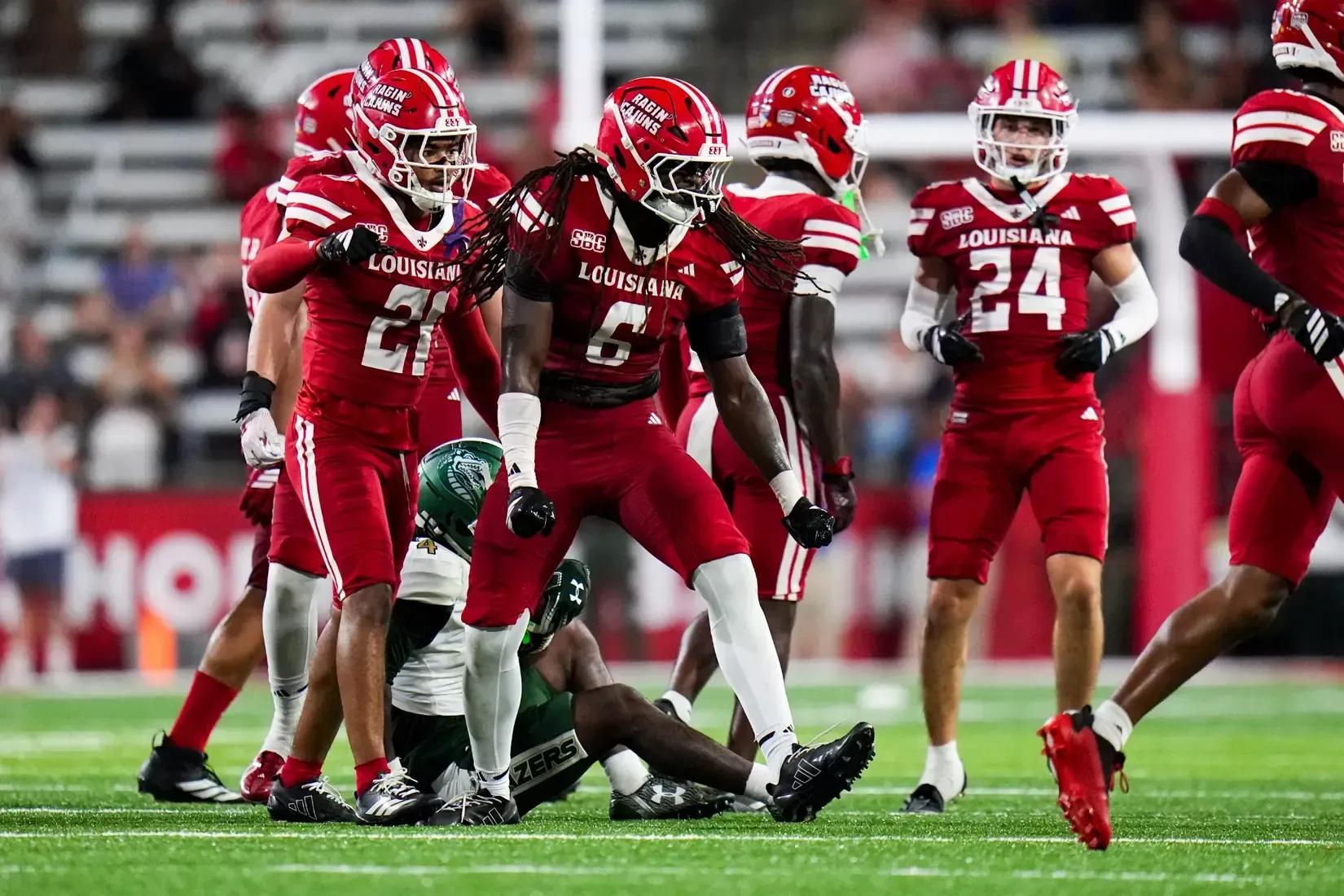
Defensive back Brent Gordon Jr. was all over the field in Charlotte, finishing with seven tackles, two pass breakups, an interception, two forced fumbles and a fumble recovery. That earned him Sun Belt Defensive Player of the Week honors, just one week after Collin Jacob earned the same award following the win over UAB, when Louisiana held the Blazers to 218 total yards.
This defense has shown a lot of talent and appears to be one of the best units not only in the Sun Belt, but among the Group of 6. Head coach Michael Desormeaux said Tuesday that he still doesn’t think this defense is anywhere close to reaching its full potential. But considering how well it has already played, that’s a pretty encouraging thought heading into conference play.
The Offense Revolves Around Lunch Winfield’s Legs
The offensive side has proven to be a little more complicated. Coming into the season, we knew Louisiana was going to need some guys to step up at wide receiver. The Cajuns lost several proven playmakers, while Shelton Sampson Jr. was expected to lead the group after finishing with 537 receiving yards last season despite missing time with injury.
But so far through four games, Sampson has yet to have a reception following a week one injury to his ankle in the first quarter. Landon Strother was also working his way back from a collarbone injury suffered during fall camp, so suddenly to start the season, Louisiana was without their two starting outside receivers.
Because of that, a lot of the offense has fallen on quarterback Lunch Winfield, especially with his legs. Through four games, Winfield has rushed for 295 yards and six touchdowns, averaging nearly 74 yards per game. Six of Louisiana’s 16 offensive touchdowns have come from him on the ground.
The passing game hasn’t been nonexistent, but it hasn’t exactly been explosive either. Winfield has thrown for 660 yards and two touchdowns. Redshirt freshman Russell Babineaux has stepped up with 116 receiving yards, while KeDarius Wade and tight ends Caden Jensen and Brock Chappell have also made plays when needed.
Not eye-popping numbers to say the least, and the deep passing threat has been pretty limited. That’s not exactly shocking with such a young receiving room, but it is something Louisiana will eventually need more of as the competition gets tougher.
The good news is the Cajuns are finally getting healthier. Strother came back against UAB in week three, where he played a big role in the narrow victory. Sampson returned against Charlotte last weekend in a limited role. Trenton Chaney, who also injured his ankle week one, is back in the lineup as well.
Maybe that changes what this offense looks like over the next few weeks. It needs to, because Louisiana’s offensive production has gone in the wrong direction since the opener. The Cajuns had nearly 475 yards of offense against Lamar. Against Charlotte, they finished with fewer than 300. They still won 34-7, but the defense and turnovers played a big role in creating that margin.
That’s probably my biggest concern heading into conference play. What happens when Louisiana plays a team where the defense isn’t completely controlling the game? Against Charlotte, Winfield was held in check both through the air and on the ground. Luckily, Charlotte’s offense was nowhere good enough to create any spark.
For now, every team preparing for Louisiana is going to start with the same thing: figuring out how to contain Lunch Winfield.
Updated Record Prediction
Before the season, I really didn’t know what to expect from this team. The schedule looked favorable, but this was also a young group coming off a season where injuries caused problems seemingly every week. That’s why I had Louisiana’s floor at 4-8, its ceiling at 11-1 and ultimately predicted an 8-4 finish.
Four games later, I certainly feel better about this team than I did before the season. The Cajuns have won the games they were expected to win and lost the one they were expected to lose (and played better in that game than many expected). But the biggest thing that has changed my outlook is how good this defense looks.
Here’s where I stand now:
Absolute floor: 7-5
Projected record: 9-3
Absolute ceiling: 11-1
If Louisiana can stay relatively healthy, I really don’t see a reason why this team can’t win at least half of its eight conference games and finish no worse than 7-5. Defensively, I think this is one of the better units in the Group of 6 right now, and that alone should give the Cajuns a chance in just about every game left on the schedule.
On the other end, I also think this team has the potential to win out and play in the Sun Belt Championship Game. We know the defense is capable of getting them there. The question is whether this offense can improve enough to consistently play four full quarters. Maybe getting Sampson, Strother and Chaney back helps make that happen, but we need to see it first.
For now, I’m predicting Louisiana finishes 9-3, with losses to Louisiana Tech and Georgia State. Louisiana Tech may only be 1-2, but its two losses came against LSU and Baylor, and the Bulldogs played well at times in both games, especially defensively. Add in the renewal of the rivalry and a road trip to Ruston, and I think that will be one of the toughest games left on the schedule.
Georgia State is another one. The Panthers are 3-1 and have shown plenty of ability to move the ball offensively, and Louisiana has to travel to Atlanta for that matchup in the final week of the regular season.
Originally, I thought Louisiana’s toughest stretch would come in mid-October against Louisiana Tech, Troy and Southern Miss. Four games into the season, that doesn’t look quite the same. Southern Miss has been disappointing so far, and Troy hasn’t really lived up to preseason expectations either. But that’s how college football goes.
A lot can change in four weeks, and plenty more will change over the next two months. But right now, I think we have a much better idea of what this Louisiana team is than we did before the season, and it’s trending in the right direction. The defense looks legitimate, Lunch has become the centerpiece of the offense, and the receiving corps is finally getting healthier.
Now we get to see how all of that carries over into Sun Belt play. So, my prediction heading into conference play: 9-3 overall, 7-1 in conference play and a trip to Harrisonburg, Virginia to play former UL head coach Billy Napier and the James Madison Dukes in the Sun Belt Championship Game.
A quick share helps us a lot!