Fall Ball Matters More Than Ever for Nicholls Softball Entering 2027
Colonels will use a seven-game home fall schedule to begin replacing major production from a 31-win team
THIBODAUX, La. — Fall softball is normally about development, getting younger players comfortable and giving coaches a chance to experiment.
For Nicholls, this fall feels a little more important than that.
The Colonels enter preparation for the 2027 season coming off another 31-win campaign, but head coach Ron Frost and his staff have some significant questions to answer before February. Nicholls lost a large portion of the lineup that carried the offense in 2026, along with the three pitchers who handled nearly all of the innings in the circle.
That makes this seven-game fall schedule less about wins and losses and much more about discovery.
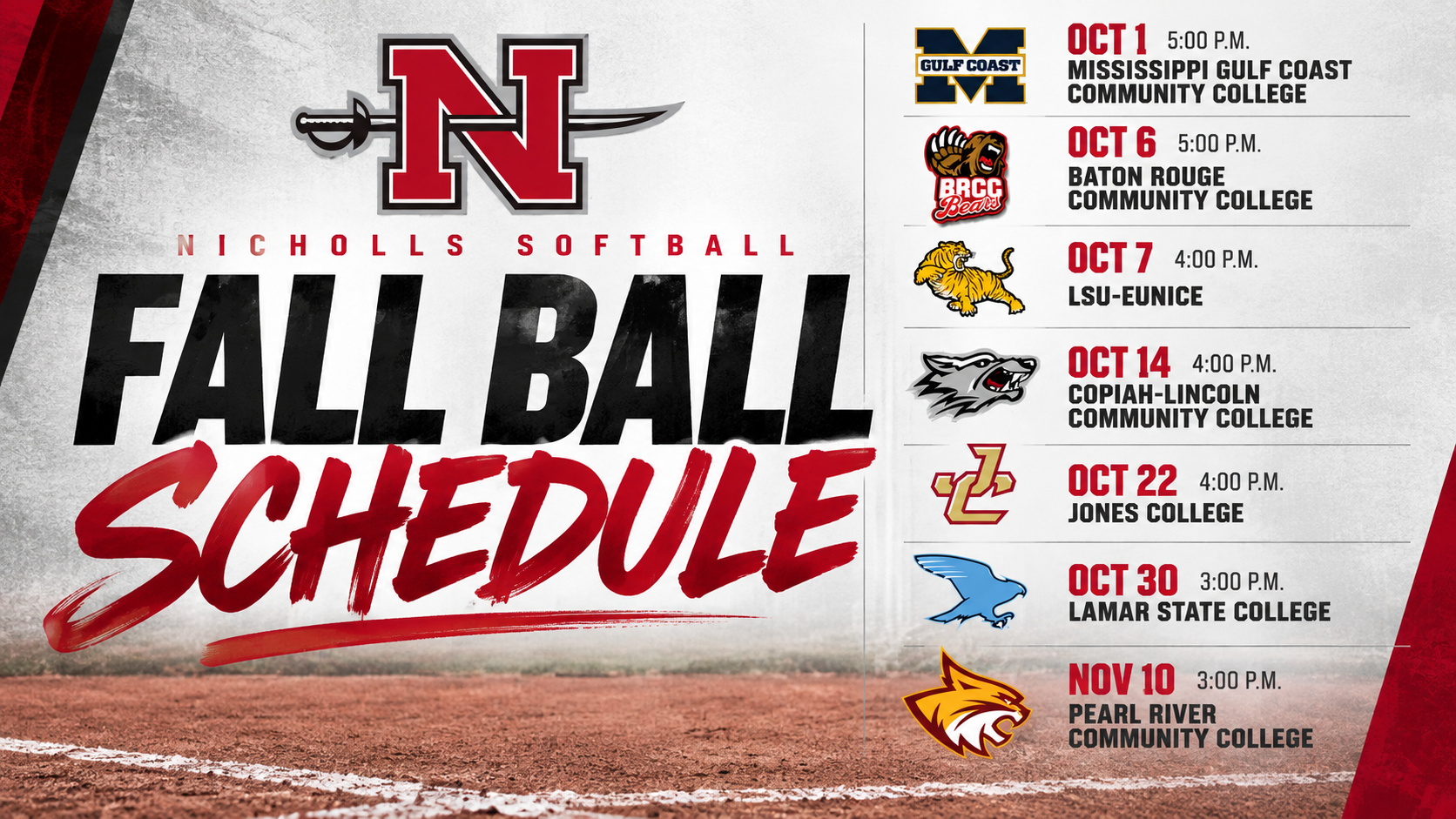
Nicholls will play all seven fall games at Swanner Field at Geo Surfaces Park, beginning Oct. 1 against Mississippi Gulf Coast Community College. The Colonels will also host Baton Rouge Community College on Oct. 6, LSU-Eunice on Oct. 7, Copiah-Lincoln Community College on Oct. 14, Jones College on Oct. 22, Lamar State College on Oct. 30 and Pearl River Community College on Nov. 10.
For Frost, those games provide seven opportunities to begin figuring out what the next version of Nicholls softball will look like.
A Good 2026 Season, but an Incomplete Finish
Nicholls finished 2026 at 31-23, reaching the championship game of its Southland Tournament bracket for the second consecutive season before falling 7-6 to McNeese. It was also the fourth straight postseason in which the Colonels won at least two tournament games.
Offensively, Nicholls was one of the better teams in the Southland. The Colonels hit .301 as a team, scored 297 runs, collected 429 hits, and finished with 81 doubles, 33 home runs and 106 stolen bases.
The problem heading into 2027 is just how much of that production has to be replaced.
Claire Sisco led Nicholls with a .398 average, 70 hits, 52 runs and 29 stolen bases. Madison Moak hit .369 with 17 doubles, six home runs and 37 RBIs. Erin Krause hit .327 and led the team with 40 RBIs, while Reagan Heflin hit .304 and drove in 37. All four started all or nearly all of the season.
All four were seniors last season.
That means Nicholls isn't simply replacing a couple of starters. The Colonels are replacing their top four qualified hitters from last season.
They also have to replace Laylin Sturm, who scored 34 runs and stole 25 bases; Lilianna Robledo, who started 50 games and drove in 27; Brynne Songy, and Kayleigh Lugowski, who earned First Team All-Southland honors as a designated player after hitting .359 in conference play with five home runs.
That's a lot of at-bats, experience, and familiarity leaving the lineup at once.
The Biggest Question May Be in the Circle
As much as Nicholls has to replace offensively, pitching could be the biggest storyline of the fall.
Molly Yoo, Sierra Ouellette and Averi Paden combined to throw 309 of Nicholls' 346.1 innings last season. They also accounted for 29 of the Colonels' 31 victories.
Yoo carried the largest workload, finishing 17-11 with a 3.17 ERA over 161.1 innings while striking out 101. Ouellette went 6-5 with a team-best 2.88 ERA, and Paden went 6-5 with a 3.59 ERA while adding two saves.
All three were seniors.
That immediately makes the fall important for sophomore Ashley Little. Little is the most experienced returning pitcher after appearing in 17 games with seven starts as a freshman. She went 2-1 with a 5.10 ERA over 35.2 innings, striking out 28.
Macie McLellan also returns after spending her freshman season on the roster, and the Colonels have added junior pitchers Keira Bell and Kaitlyn Davis to the 2027 group. Bell is listed as a pitcher/outfielder after transferring from Florence-Darlington, while Davis comes to Nicholls from Volunteer State Community College.
Who starts? Who can eat innings? Who can pitch in the back end of games? Can Nicholls develop a true No. 1 starter, or will Frost use a deeper staff?
Those are questions that can begin being answered in October rather than February.
Higbee Gives Nicholls an Experienced Bat to Build Around
There is still experience returning.
Gabby Higbee will be back for a fifth season after starting 52 games in 2026. She hit .273 with 42 hits, 14 doubles and 31 RBIs. Among players currently listed on the 2027 roster, she easily brings the most established production from last season.
Her presence should help stabilize an outfield that will otherwise look different.
Ally Mooneyham is another name worth watching closely. Her 2026 season was limited, but Nicholls already knows what she is capable of producing. She hit .352 in 2025 with a .427 on-base percentage, scoring 25 runs and stealing 10 bases.
If Mooneyham can return to that level offensively, it would immediately solve one of the biggest questions in the lineup.
The Colonels also return Sydney Mann, Alyssa Naquin, Nevanna Smith, Aubrey Delatte, Trinity Johnston, Hailee Sanchez, Ava Burkett and McLellan among others. Several had limited roles last season, which is exactly why the fall becomes valuable.
Nicholls doesn't necessarily need every returning player to become a star. It needs to find which players are ready for larger roles.
Plenty of New Faces
The 2027 roster also shows just how much competition there will be.
Nicholls currently lists 29 players, with a significant number of freshmen and several transfers mixed with the returning group. Among the newcomers are Bell, Davis and UTEP transfer Jordan Credeur, along with freshmen Avery Keel, Abby Dagro, Bella Mann, Kaitlyn De La Fuente, Macey Frank, Lauren Baudoin, Brianna Duffey, Kailee James, Hayden Traub, Addison Goodin and Marissa Gianneschi.
That makes these fall games essentially an extended evaluation period.
It gives the coaching staff an opportunity to move players around defensively, change batting orders, give freshmen meaningful innings and see how transfers fit alongside the returning players.
There is also a leadership component.
Last year's team had seniors all over the field. Sisco, Moak, Krause, Heflin, Robledo, Songy and the veteran pitching staff had been through Southland weekends and postseason games.
Someone else now has to become that voice.
What to Watch This Fall
The scoreboard will be the least important part of the next seven games.
Watch who Frost puts at the top of the batting order. Watch which players consistently get opportunities in the middle of the lineup. Watch how the middle infield takes shape with Krause and Robledo no longer there. Watch the competition behind the plate and in the outfield.
But especially watch the circle.
Nicholls knew exactly where most of its innings were coming from last season. Yoo, Ouellette and Paden handled nearly 90 percent of them.
That luxury is gone.
The Colonels have an experienced piece in Little, some returning options and new arms arriving, but the staff hierarchy has to be rebuilt almost completely.
And that is why this fall matters.
Nicholls isn't trying to determine whether it can compete after winning 31 games in back-to-back seasons. The bigger question is which players are ready to take ownership of a team that suddenly has opportunities everywhere.
By February, Frost will need answers.
October and November are where he gets to start finding them.
A quick share helps us a lot!