Nicholls Returns Home for Early Southland Test Against UTRGV
Colonels and Vaqueros enter Saturday at 1-1 after experiencing both ends of the spectrum through the first two weeks of the season
THIBODAUX, La. — Two games into the 2026 season, Nicholls and UTRGV have already experienced just about everything.
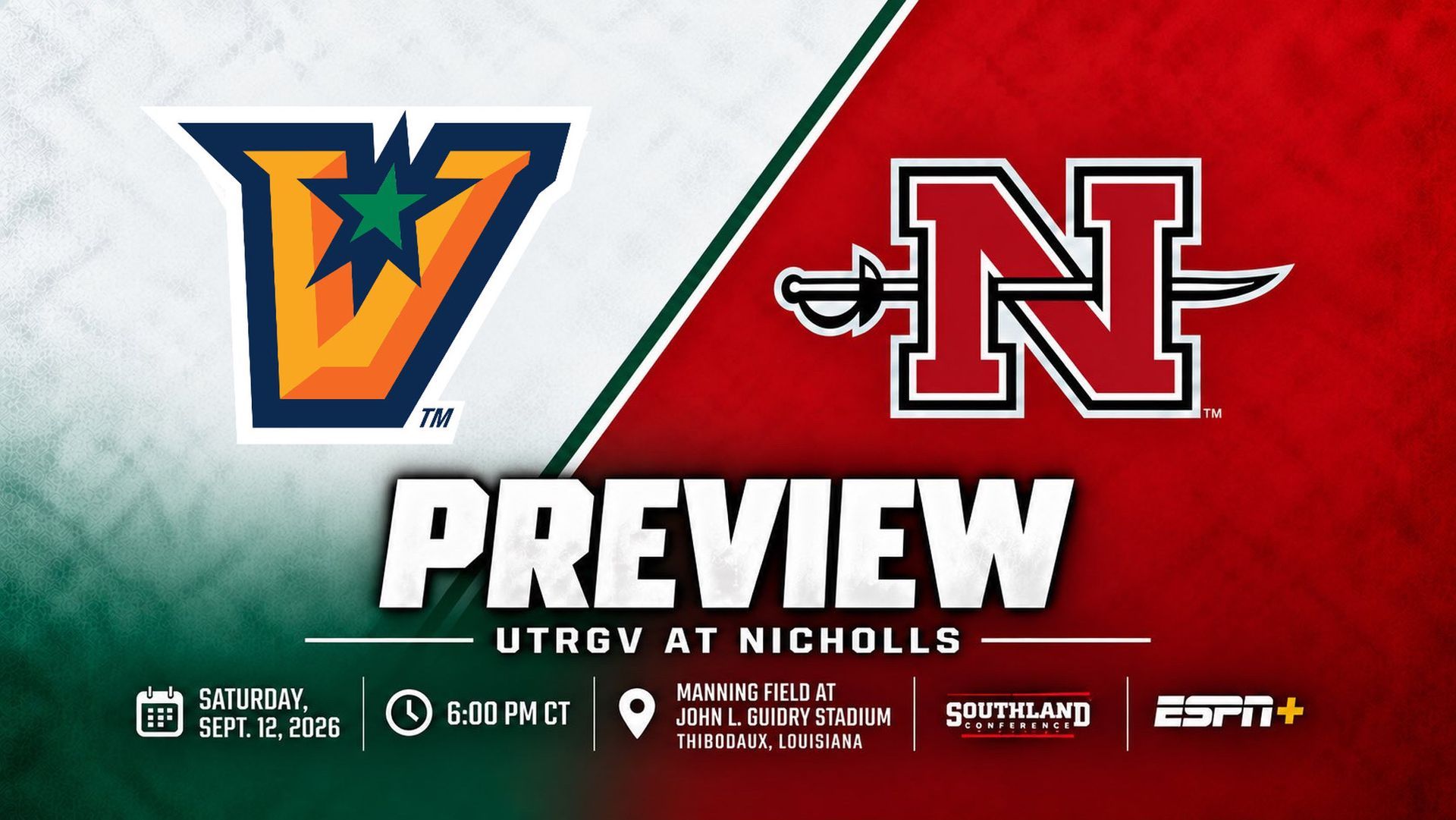
Both teams opened the year with convincing wins. Both followed those performances by stepping up against FBS competition and taking difficult losses. Now, the records reset in a sense as the Colonels and Vaqueros meet Saturday night at Manning Field at John L. Guidry Stadium in an early Southland Conference matchup.
Kickoff is scheduled for 6 p.m. on ESPN+. Both teams enter at 1-1.
For Nicholls, the challenge is putting a 71-3 loss at Kansas State behind it and rediscovering the team that looked explosive and opportunistic in a 44-10 season-opening win over Mississippi Valley State. UTRGV is trying to do something similar after following a dominant 44-0 shutout of UT Permian Basin with a 45-16 loss at UTSA.
Nicholls: Two Completely Different Saturdays
The first two games have painted two dramatically different pictures of the Colonels.
Against Mississippi Valley State, Nicholls controlled the game from the beginning. The Colonels built a 37-0 halftime lead behind three Ean Rodrigue touchdown passes, two rushing touchdowns from Tamaj Hoffman and a defense that forced four turnovers. Nicholls finished the night with 516 yards of offense, including 347 through the air and 169 on the ground.
A week later in Manhattan, very little went right.
Kansas State held Nicholls to only 122 total yards, including 92 rushing and 30 passing, while the Wildcats piled up 559 yards in the 71-3 win. It was the type of mismatch that can dramatically skew early-season statistics, especially through only two games.
Through two games, Nicholls is averaging 319 yards per game, with 130.5 coming on the ground and 188.5 through the air. The Colonels have scored six offensive touchdowns but have also turned the ball over three times. Defensively, Nicholls has allowed 393.5 yards per game, although 559 of those yards came against Kansas State.
That is why Saturday should provide a much clearer measuring stick for where this Nicholls team stands.
Rodrigue and the Nicholls Offense Need to Reestablish Rhythm
Quarterback Ean Rodrigue had a tremendous opener before the entire passing game was shut down at Kansas State.
Through two games, Rodrigue is 23-of-44 for 294 yards with three touchdowns and one interception. All three touchdown passes came against Mississippi Valley State.
The Colonels have shown that they have some explosive options when Rodrigue has time.
Greg Donaldson has 100 receiving yards on only three catches, including a 74-yard touchdown, while Jordan Smith has four receptions for 94 yards and two touchdowns. Those numbers are small-sample statistics, but they also show Nicholls has players capable of changing a game quickly.
Hoffman has been the most productive player on the ground with 96 yards on 16 carries, averaging six yards per attempt with two touchdowns. Rodrigue has also contributed 53 rushing yards.
One of the biggest questions Saturday will be whether Nicholls can get back to playing balanced football.
Against Mississippi Valley State, the Colonels were able to stay ahead of the chains and attack downfield. At Kansas State, that opportunity disappeared almost immediately.
UTRGV should provide a much more realistic test.
UTRGV Has Shown It Can Move the Football
The Vaqueros' 1-1 record looks similar to Nicholls', but their offensive numbers through two games are considerably stronger.
UTRGV erupted for 675 total yards in its 44-0 win over UT Permian Basin, throwing for 404 yards and rushing for 271. The Vaqueros controlled possession for nearly 39 minutes and produced 29 first downs.
Even in the loss to UTSA, UTRGV still generated 422 yards of offense, including 177 rushing yards and 245 through the air. The Vaqueros actually held the ball for 34:49 despite losing 45-16.
That matters.
This is not an offense that has completely disappeared when the competition increased.
Garret Rangel started against UTSA and completed 19 of 32 passes for 152 yards. Broderick Taylor was one of UTRGV's bright spots on the ground, rushing for 73 yards, including a 54-yard run. Jaydon Smith led the Vaqueros with 68 receiving yards.
UTRGV's opener also showed its depth. Rangel threw for 211 yards against UTPB, while Aidan Jakobsohn added 180. Kyran Lee had 141 receiving yards, Corey Holmes had 119 and Brennan Carroll rushed for 84 yards on nine carries.
Through the first two weeks, UTRGV has rushed for 448 yards, an average of 224 per game, while throwing for 649 yards, or 324.5 per game. That is nearly 550 yards of offense per game, although the level of competition has obviously varied significantly between UTPB and UTSA.
The Battle Up Front Could Decide It
If there is one matchup that should immediately grab Nicholls' attention, it is UTRGV's running game against the Colonel front seven.
Nicholls has surrendered 461 rushing yards through two games, an average of 230.5 per game and 6.2 yards per carry. Kansas State accounts for a large portion of that, but the number still stands out heading into a matchup against a UTRGV offense averaging more than five yards per rushing attempt through two games.
If UTRGV can consistently create second-and-medium and third-and-short situations, the Vaqueros could control the tempo and keep the Nicholls offense standing on the sideline.
For the Colonels, winning first down may be as important as anything Saturday night.
Nicholls does not necessarily need to shut down UTRGV's rushing attack. It needs to keep it from controlling the game.
Turnovers Could Swing This One
Nicholls showed in Week 0 how different it can look when the defense creates takeaways.
The Colonels have forced seven turnovers through two games, including three interceptions and four recovered fumbles. Nearly all of the damage came in the opener when Nicholls repeatedly gave its offense favorable situations against Mississippi Valley State.
UTRGV has not been perfect protecting the football.
The Vaqueros lost two fumbles against UTPB and committed two turnovers against UTSA. Against a Nicholls defense that has already demonstrated an ability to create takeaways, protecting the football will be critical.
Nicholls may not want Saturday to become a game where it has to produce 500 yards of offense. Short fields and an extra possession or two could completely change the matchup.
Third Down Is Another Number to Watch
Nicholls has converted just 11 of 32 third downs, good for 34.4 percent, while opponents have converted 52.2 percent against the Colonel defense.
UTRGV, meanwhile, went 7-of-15 on third down against UTPB and 7-of-19 at UTSA.
That makes third down one of the clearest potential swing areas.
For Nicholls, getting UTRGV off the field could prevent the type of long drives that wear down a defense. Offensively, converting a few more third-and-manageable situations would allow Rodrigue and the Colonels to establish the tempo they showed in the opener.
A Chance to Answer Last Year's Loss
There is also some history attached to Saturday's matchup, even though there isn't much of it yet.
The programs met for the first time last season in Edinburg, where UTRGV defeated Nicholls 28-21. The Vaqueros scored seven points in every quarter while Nicholls spent the night trying to catch up.
Rodrigue threw for 193 yards in that matchup, while UTRGV quarterback Eddie Lee Marburger passed for 247. The Vaqueros finished with 392 yards of offense compared with 326 for Nicholls.
That victory was part of a remarkable inaugural season for UTRGV, which reached seven wins with the victory over Nicholls.
Saturday will be the Vaqueros' first trip to Thibodaux.
What to Watch Saturday
Can Nicholls forget Manhattan?
This may be the biggest question of all. A 71-3 loss can linger if a team allows it to. Saturday gives the Colonels an immediate opportunity to establish that Kansas State was one night against a Big 12 opponent and not an indication of where the season is headed.
Can Nicholls slow the UTRGV rushing attack?
The Vaqueros have already rushed for 448 yards. If they consistently win at the line of scrimmage, Nicholls could have trouble getting its defense off the field.
Does Rodrigue get the explosive passing game back?
Donaldson and Smith have already shown big-play ability. Nicholls needs more opportunities to get the football into their hands downfield.
Who wins the turnover battle?
This may be the simplest path to a Nicholls win. The Colonels have shown they can create takeaways, and those extra possessions could be huge in what should be a much more competitive matchup.
Can Nicholls establish Hoffman early?
Hoffman averaging six yards per carry is encouraging, but the Colonels need more consistent production from the run game. Establishing him early would take pressure off Rodrigue and open up the play-action game.
A Much Better Measuring Stick
It is difficult to make definitive statements about either team based on the first two games.
Nicholls looked dominant against Mississippi Valley State and overwhelmed against Kansas State. UTRGV looked dominant against UT Permian Basin and much more vulnerable against UTSA.
Saturday removes some of those extremes.
It is an FCS-versus-FCS matchup. It is an early conference game. It is a home game for Nicholls. And it comes against a UTRGV program that proved last season it could immediately compete in the Southland.
For the Colonels, Saturday is not simply about bouncing back from Kansas State. It is an opportunity to show what kind of football team Nicholls intends to be in 2026.
The season opener showed what the Colonels are capable of when the offense finds rhythm and the defense creates turnovers. Kansas State showed how quickly things can get away from them when neither happens.
UTRGV should tell us much more.
Kickoff: Saturday, Sept. 12, 6 p.m.
Location: Manning Field at John L. Guidry Stadium, Thibodaux
Records: UTRGV 1-1, Nicholls 1-1
TV: ESPN+
A quick share helps us a lot!