I-59 and Back: Will Hall's Journey
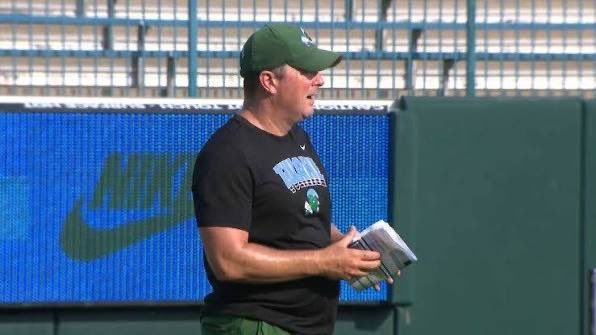
How failure at Southern Miss forced Will Hall to confront himself, travel the country in search of answers, and return stronger to try and lead Tulane.
Failure does not always arrive with a single, dramatic collapse. Sometimes it arrives as a slow, grinding erosion, one loss after another, one season after another, until the weight becomes impossible to carry. For Will Hall, that weight settled fully on a Sunday evening in October 2024.
Southern Miss fired him after a 1-6 start to his fourth season. The final record stood at 14-30. The 2022 season, a 7-6 campaign capped by a LendingTree Bowl victory, felt like a distant memory.
What remained was the hard truth that the program had not moved forward under his watch in the way anyone, least of all Hall himself, had envisioned.
Most coaches in that moment retreat into bitterness, silence, or the next available job. Hall did something rarer. He treated the failure as a teacher rather than a verdict.
Shortly after being let go, Hall was already on the Tulane practice field. Not as a visitor seeking employment, but as a coach who needed to be around the game again. In the weeks that followed, he deliberately stepped off the treadmill of the coaching carousel. He traveled. He watched. He listened. He went to Houston to sit with Willie Fritz, the man who had once given him the offensive coordinator job at Tulane. He spent time at Army. He visited Oregon. He stopped at Jacksonville State. These were not networking trips. They were intentional acts of study, visits to programs that had figured out how to sustain success at a high level.
What Hall discovered on those trips was not a single schematic secret. It was something more fundamental about himself.
At Southern Miss he had drifted into the role of CEO and fundraiser. The job of modern head coach had pulled him away from the field, away from the daily teaching that had defined his earlier success at West Alabama and West Georgia, where he went 56-20 and made four playoff appearances. “I’m not a CEO,” Hall would later say with quiet clarity. “I have to coach on the field. The CEO route, I tried it and it doesn’t work for me.”
That realization did not come easily. It required the humility to admit that the version of himself that succeeded as a lower-level head coach and as an offensive coordinator had been diluted by the demands of an FBS head job.
The trail of those visits forced him to confront the gap between who he had become and who he needed to be.
When the opportunity came to return to Tulane in January 2025 as pass game coordinator and wide receivers coach under Jon Sumrall, Hall took it without hesitation. He returned not as a former head coach demanding the title, but as a teacher hungry to work. The role put him back on the grass, back in the meeting rooms, back in the daily work of developing players.
One year later, when Sumrall left for Florida, Tulane turned to the man who already knew the program, the city, and most importantly the hard lessons of the previous chapter.
In December 2025, Will Hall was named head coach of the Green Wave.
The story is not one of simple redemption. It is one of deliberate progression. Hall did not pretend the Southern Miss years never happened. He examined them. He traveled to understand how successful programs sustain themselves. He returned to a place that already knew his strengths and asked to be judged on the version of himself that had been refined by failure.
There is a quiet power in that sequence.
Many coaches experience setbacks. Fewer use them as a mirror. Fewer still leave the comfort of their own system long enough to study someone else’s. Hall did both.
The trails at Southern Miss became the trail that led him back to New Orleans with clearer eyes and a renewed conviction about how he wants to lead.
In the end, the measure of a coach is not only the wins recorded on a résumé. It is the capacity to learn when the record turns against him. Will Hall’s path from the firing in Hattiesburg to the head coaching chair at Tulane is a living example of that capacity. The failure was real. The learning that followed was more real still. And the Green Wave program now stands as the place where that hard-earned growth will be tested and, if history is any guide, put to use.
“Success is not final, failure is not fatal: it is the courage to continue that counts.”
— Winston Churchill
A quick share helps us a lot!