Why Does Everyone Want Trey Murphy?
Breaking down why the buzz around every team eyeing Trey Murphy is justified.
Dunks and threes, for many new-aged thinkers, are the two best shots in basketball.
It’s no coincidence that a player who splashes deep threes and throws down 100+ dunks a season is extremely sought after.
The number of guys who can accomplish both? That’s an exclusive club of hoopers, and even more so when you whittle it down to those who do it at 6’8+.
It’s no secret that the Pelicans are getting constant calls about Trey Murphy.
Trey Murphy epitomizes the modern NBA has become: a player who’s the size of an old-era center, ripping nets from 30+ feet and attacking closeouts with extreme vertical authority.
The real question is… is it really that simple?
And if it isn’t just about finding an asset whose highlight mix pops like Murphy’s — then what makes the Pelicans line ring so much that the front desk is starting to get irritated?
What’s the Hype?
Trey Murphy being Mr. Dunks & 3s1 doesn’t automatically make him an impactful player, and the constant inquisition that Pelicans brass is getting about Murphy isn’t because they want to put butts in seats or entertain fans.
From a roundball purist’s standpoint, what’s his impact on winning games?
Simply put, Trey Murphy is an elite offensive threat and probably one of the best complementary players in the NBA.
It all starts with the reason why he was drafted — shooting.
Murphy is now a highly efficient, versatile shooter and one of the league’s premier deep threats.
The catch-and-shoot has become an incredibly easy component for the former #17 overall draft pick.
Murphy ranks 2nd overall in bball-index.com’s C&S 3PT Shot Making metric and 5th in C&S 3-point efficiency.
What was once his game’s value is now a building block for a more versatile shot diet, starting beyond the arc.
Functionally, Murphy’s shooting is extremely versatile from three. His points per possession rank in the 96th percentile in spot-up playtypes, and in off-screen possessions, he ranks in the 91st percentile. The ability to be a high-level shooter already forces the defense to bend a knee; that pressure on a defense only increases tenfold when it can be done from the logo.
Murphy’s range is not only exhausting for opposing coaches to gameplan for, but it stretches defenses to their absolute limit.
Call it more bball-index propaganda if you’d like, but Murphy ranks 2nd in the NBA in their Deep 3PT shot-making metric and 4th overall in Deep 3PT shooting talent. His average distance on a 3pt attempt is 26.56 feet, which ranks 11th in the league.
Even the best defenses usually don’t have the bandwidth to cover this far from the rim; it tests and punishes their help principles or takes the defender out of the play altogether.
This is all while the Pelicans have some of the worst spacing on the roster in the NBA. With Murphy being their only proficient outside threat, it’s easier for teams to top-lock him on pin-downs and off-ball screens or sacrifice some of their normal help-concepts to stay glued to his hip.
Because of the limited personnel in that area, Murphy’s development of an off-the-dribble 3-ball is something many are keeping a close eye on. His staggering shooting numbers have yet to translate to this portion of his game, as he ranked just above league average in OTD three-point % this past season.
Granted, if Murphy’s off-the-dribble deep-ball caught up even slightly to the rest of his shooting, another offensive ceiling is punched through, and the conversation shifts entirely.
~ Development Sidebar ~
As Trey Murphy’s game has grown and the Pelicans roster has seen substantial turnover, his on-ball responsibility has increased significantly.
While Murphy likely won’t be a primary ball-handler on a contender, his value as a secondary creator is promising. Though isolation lowers his efficiency, his playmaking growth is encouraging.
Among all wings, Murphy ranks 7th in rim assists, averaging 2.6 a game. Considering Murphy’s evolving role requires more playmaking, his growth as a facilitator, and improved court vision, all of which are evident.
Since the playmaking is there, Murphy’s ceiling as a secondary ball-handler will depend upon the key domino of getting defenders to respect and overplay a quick trigger three off the bounce, which will allow him to get downhill or separate when he might not normally be able to.
Still, whether Murphy develops further as an on-ball option is almost irrelevant to his widespread appeal in the NBA.
I’ve noted Murphy’s elite spacing, range, and efficiency. At minimum, his off-the-bounce game makes him a top-tier closeout attacker, a skill he’s showcased.
Regardless of what you make of Murphy when he has the rock, his above-the-rim athleticism, feel as a cutter, and ability to attack closeouts with gumption — all of which are special and unquestionably make him a top off-ball guy — it’s all that noise he’s making in that area that is the foundation of his game.
That was on full display this year. That, as his primary, leaving on-ball scoring as a tertiary, doesn’t make him an offensive engine, but it does make him damn good offense. — and that growth is clearly indicated in his shot-chart from last year to this one.
In half-court settings, defenses emphasize taking away his air space, and Murphy knows exactly how to leverage his flamethrower of a jumper to create easy buckets at the rim.
Teams overplaying off-screen actions and attempting to suffocate Murphy’s space were apparent all season long, and he punished them the entire way through it.
This dynamic cutting was already a significant part of Murphy’s game, but by the end of the 2025-26 season, it had become a hallmark for him. He solidified himself as a first-class movement threat—not only because of the new opportunity to play with a passer like Derik Queen, but also because of the continued respect he commanded as a high-volume outside threat.
Bballindex’s player progression supports this, as Murphy’s shot-making as a mover is in a tier of its own.
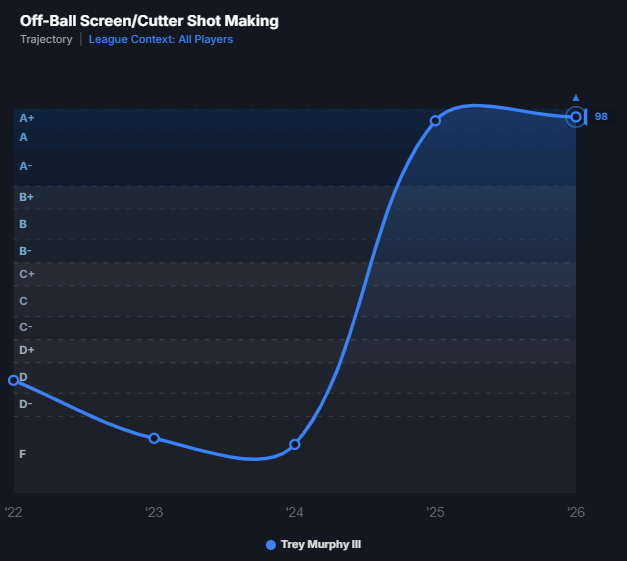
All while done in a less-than-efficient offense with inferior spacing, consider this: Imagine the nightmare teams have to endure if their third guy to account for is Trey Murphy, not their first.
Hence why every team in the NBA has been rumored to eye him, he ranks 5th in Bball Index’s off-ball shot making and efficiency, all while having a C+ (59th percentile) off-ball shot quality.
These metrics highlight Murphy as an offensive optimizer, and that complementary ability is paramount to his assessed value around the league.
Murphy’s capacity to finish plays at the rim, mixed with being a topline shooter, can be a huge void filled for teams that don’t have support from their wings. Obviously, if Murphy were a 3rd of the 4th-best offensive player on a contender, he’d be extremely overqualified for his role, functioning as an offense’s closeout punisher, cutter, and high-volume spot-up shooter, like having an Aston Martin as the third car.
Murphy averaged 1.27 points per possession on spot-up opportunities (96th percentile).
1.51 points per possession on cuts, 7th in the NBA among all wings.
1.23 points per possession in off-screen plays (91st percentile).
Even with a quick query search, you can see that the list of players who shoot above 70% at the rim, along with 7.5 or more attempts from three a game, is incredibly short, and Murphy is towards the top of it. Murphy is one of the only players in the NBA with these capabilities.
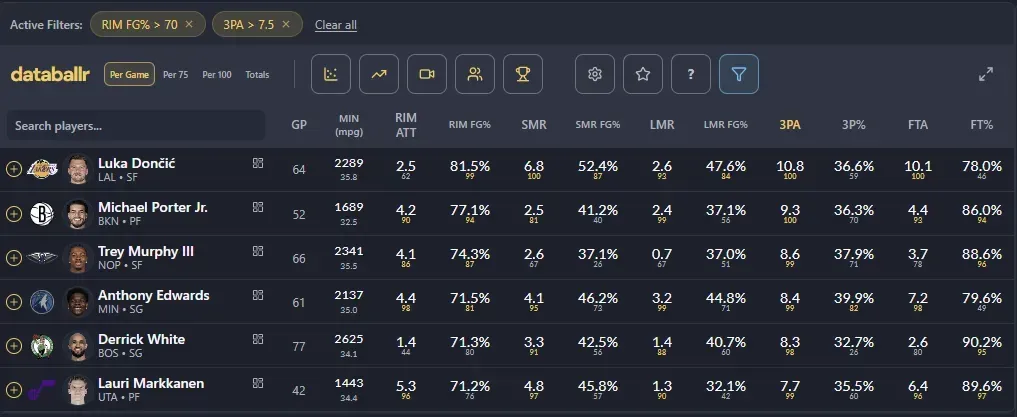
Those two stats sum up the draw pretty plainly.
Wings with his size, shooting capability, and athleticism, with the finishing prowess to back it up, is an exceptional player that comes around seldomly, so it’s no wonder that Joe Dumars phone is flooded with calls.
Not to mention his aptitude in transition, scoring 1.23 points per possession in that playtype (92nd percentile).
Murphy uses his bounce and length on the open floor; his physical traits allow him to excel in transition, making him an asset for a faster-paced team. The Pelicans made the most out of their pace this season, and Murphy backed their approach by executing often.
Murphy leans more toward three. Defensively, he’s fluctuated between average and below-average, ranking in the 48th percentile in defensive EPM this season. When facing a more physical scoring wing, he gets pushed around in isolation, and most of his matchups reveal it, leading to easy looks. Murphy also struggled to navigate ball screens and get behind actions, so he was used less as a POA defender and more as a helper.
However, where Murphy does make his mark is in passing lanes, using his wingspan to disrupt: he averages 2.8 deflections (91st percentile) and 1.7 forced turnovers (92nd percentile).
If Murphy were to be traded to a contender, I see him being a productive helper who’s tasked with middle-of-the-road matchups. In that case, I see him being relatively effective in that role and, at the very least, remaining neutral on the defensive end.
I would find it utterly insane if the Pelicans’ front office decided to part ways with Trey Murphy — the vision has been made clear by Joe Dumars: Compete now.
If the goal is to restructure and compete 4-5 years from now, then cashing in on Murphy would be a devastating blow to the fanbase, but arguably the correct approach.
But, I don’t get the sense that building a portfolio of draft capital is the goal for the Pels brass.
Therefore, with competitiveness being the intention, trading your best offensive asset and your only shooter would be the closest thing to malpractice. Stripping this poorly constructed roster of its most portable player makes zero sense from a basketball standpoint. I’ve already beaten the “Zion desperately needs to be surrounded with shooting” and “Derik Queen is a perfect pairing with Trey Murphy” time and time again. So again, the move would be nonsensical, especially in a player-for-player deal.
Sigh, I’ve said my peace and made my plea — this front office answers to nobody but God.
Overall, Trey Murphy ranks in the 94th percentile on offensive EPM this season, proving to be what many teams think he is and garnering a hefty trade package as Desmond Bane did last summer.
Whatever his adjusted role is on another team, or if he’s suiting up for the Pels next season (for my sanity, he better) — Murphy is a big-time add for anyone, as he continues to develop, proves he’s filled with elite traits, and is highly complementary in any offensive context.
Whether the noise is just noise or there’s real momentum behind this rumor, Trey Murphy deserves the buzz. All of it is not only a proper compliment to the player he is and what he could become, but a justified market.
A quick share helps us a lot!