Tulane vs. Kansas State Recap: The Playmakers Were Dressed. The Play Sheet Wasn’t.
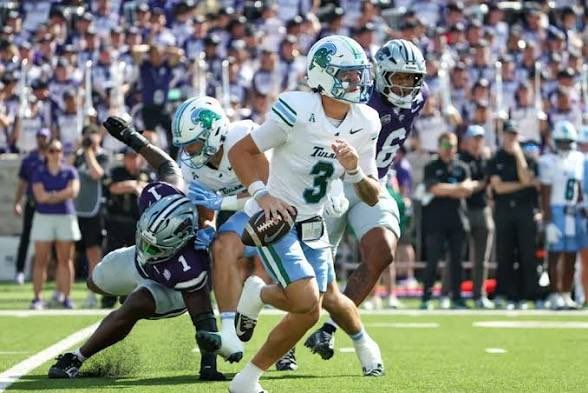
Tulane 20, Kansas State 31
Bill Snyder Family Stadium
Sept. 19, 2026
Tulane flew into Manhattan and scored the first offensive touchdown Kansas State had allowed all season. Seven plays, 90 yards, Kadin Semonza keeping the option and walking in from nine. For a quarter, the Green Wave looked like the version of this offense Will Hall and Russ Callaway have been selling since January: stay on schedule, hit a shot, finish.
Then the call sheet forgot who the best players on the field were.
Kansas State won 31-20.
Tulane is 1-2.
The box score will say 260 total yards, 13-of-26 for 165 from Semonza, 6 sacks, 4.4 yards per play. Those numbers are real. They are not the whole story. The story is who touched the football after that opening drive, and who never did.
Destyn Hill: zero catches.
Garrett Mmahat: zero.
Jaylin Lucas: 7 touches.
ABS: 1 catch
Hill is the preseason All-Conference receiver, the 61-yard threat, the guy this staff is supposed to feature when a front loads the box. Mmahat and Stephens are the complementary answers.
On Saturday they were mostly spectators in their own offense.
Oliver Mitchell Jr led Tulane with one catch for 41 yards, the strike that started the opening touchdown drive and then the vertical game went quiet.
Bredell Richardson had three for 40. Anthony Brown-Stephens had one for 22. Maurice Turner caught the late 25-yard touchdown.
Jaylin Lucas, who ran for 214 yards against South Alabama a week ago, finished with three receptions for five yards and was not the feature back.
That is not a “they just missed throws” problem. That is a usage problem.
What the first drive proved:
The opening series is the tape this staff should pin to the wall.
Semonza threw into double coverage to Mitchell for 41. The Wave stayed aggressive. They finished with an option instead of a hopeful fade. Kansas State’s defense, which had not given up an offensive touchdown in two games, blinked.
Everything after that looked like a team that did not trust the same answers. The run game still produced pieces.
Turner 7 carries for 64, Johnnie Daniels 10 for 59, but the identity never settled. Semonza was credited with 10 rushes for minus-27 yards, which is what six sacks look like on a stat sheet.
Kansas State logged 12 tackles for loss.
Once the Wave fell behind the chains, Jordan Peterson’s front lived in obvious passing downs.
That is exactly the trap my preview said this defense wanted.
Semonza does not have to throw 40 times. He has to stay on schedule and get Hill, Brown-Stephens, and Lewis (When Healthy) the ball when the box is loaded. Saturday he completed 13 passes.
The three receivers who should stress a secondary combined for zero of them.
Design, protection, and the difference between a drop and a plan.
Give the defense and the drops their share. Hall said after the game that Tulane “had our opportunities” and “just didn’t come down with the ball a few times.”
Dawson Johnson had a chance inside the Kansas State 10. Brown-Stephens had a deep ball that would have moved the sticks inside the 30. Both drives died into Cooper Helmke field goals, a school-record 58-yarder at the half and a 53-yarder in the third. Helmke was excellent.
Field goals are not how you keep pace with Avery Johnson.
Johnson accounted for 379 of Kansas State’s 428 yards: 227 passing, 152 rushing, two scores, including a 66-yarder that flipped the game after Kansas State stuffed Daniels on third-and-1.
The Wildcats converted 10 of 16 third downs. Five of those were third-and-5 or longer. Tulane has now watched Duke, South Alabama, and Kansas State live on third down with mobile quarterbacks. That is a defensive problem. It became an offensive problem the moment the Wave stopped answering with explosives of their own.
Hall’s postgame point was fair: “The difference in the game was their explosive plays.”
Kansas State created them. Tulane created one real shot to Mitchell, a late screen-and-go to Turner, and two long kicks.
That is not enough against a 3-0 Big 12 team in its building.
Protection matters here and should not be waved off as “just play calling.” Six sacks and 12 TFLs mean the offensive line, still replacing last year’s front with Reese Baker as the veteran piece, lost the point of attack for long stretches.
You cannot call deep shots if the pocket is gone on second-and-7.
You also cannot keep calling the same early-down answers after the first series fails and then act surprised when Hill is covered and Semonza is running for his life.
Those two things live together.
Bad protection shrinks the playbook. A timid playbook makes the protection look worse because every down becomes obvious.
This is Year 1. It is also Week 3.
Context still counts. Hall is in his first season as head coach. Callaway is in his first season calling this offense. The quarterback changed after Duke. Jamauri McClure hasn’t played yet, Zy Carl Lewis is banged up and the line is young.
Kansas State had not allowed an offensive touchdown and was stuffing people under 200 yards.
None of that is fake.
None of that excuses zero targets finding Hill, Mmahat, and ABS in a game Tulane trailed from the second quarter on. None of it explains why Lucas, after a 214-yard night, was used as a checkdown instead of a space player. If the plan was run-and-play-action, the play-action never stressed the secondary. If the plan was to protect Semonza, six sacks say the plan did not hold. If the plan was to feature the skill players this roster actually has, the reception list says otherwise.
Tulane was 2-for-2 in the red zone and still left points on the field because drives that should have been touchdowns became 50-yard field goals. The Wave won the first-down battle 18-20 and lost the yardage battle by 168.
That is what happens when you move the chains without threatening the paint.
What has to change before Southern Miss:
Southern Miss comes to Yulman next Saturday. That game will not wait for the offense to “find itself” in October. The fixes are not mysterious.
Get Hill the ball. Period. Motion him, stack him, isolate him, throw him the glance and the go. If Kansas State took him away, show the coverage that took him away and attack the vacated spot with Lewis/Brown-Stephens/Lucas.
Use Lucas the way South Alabama had to defend him, as a runner and as a receiver in space, not as a 1.7-yard dump-off.
Involve the tight ends on purpose, not as leftover checkdowns. Dawson Johnson and Vance Bolyard cannot be afterthoughts for a third straight week if this is a West Coast / 12-personnel offense.
Stay ahead of the chains so Semonza is not a sitting duck on third-and-long. The sacks will not vanish overnight. The down-and-distance can.
And when a drive reaches the plus-30, call the play that scores. Helmke should not be the leading scorer because the offense keeps settling.
Tulane did not lose this game only because of officials, only because of Avery Johnson, or only because of one missed tackle on third down. Those things happened. The offense also spent three quarters declining to put its best players in the spots to win.
The opening drive showed the version that can win in the American. The next 50 minutes showed a version that is still calling around its talent instead of through it.
This was a winnable game, teams too talented to be playing like this.
That can be fixed. It has to be fixed this week.
Sponsor: @RedshirtLtd
CODE: RDW 10% OFF
Licensed Tulane Lids
#RollWave
A quick share helps us a lot!