The Heart of the Problem
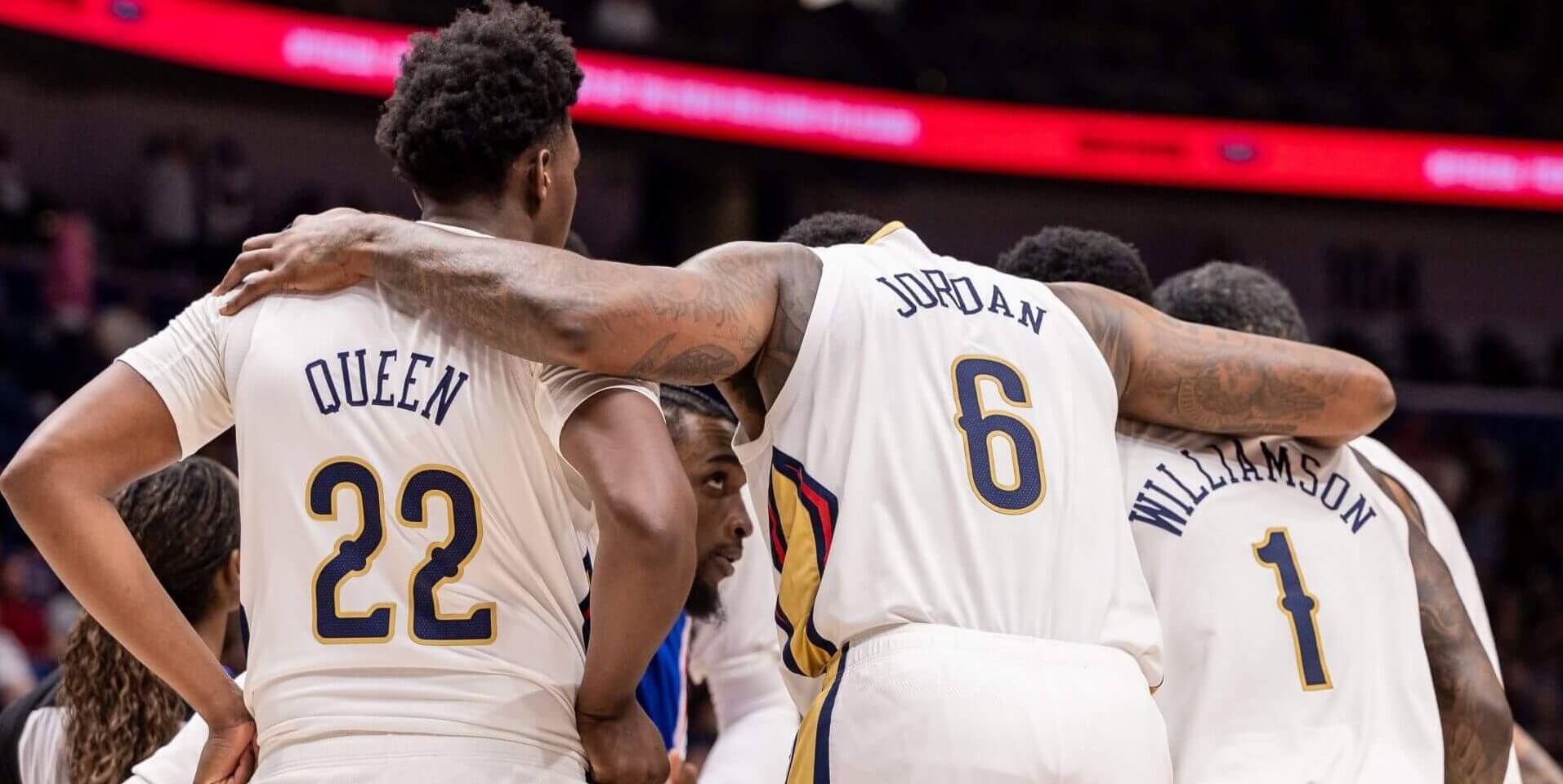
What the Derik Queen + Zion Williamson pairing says about the confused methodology of the Pelicans front office.
I hate the NBA offseason, and the team I stan hasn’t really done my lack of affinity for it any favors.
Amidst all the shakeups and chaos, the Pelicans’ offseason has been weird and awfully quiet.
It has brought about more division on social media among Pelicans fans than ever, with one side out with metaphorical pitchforks and the other unbothered by back-to-back 20-something-win seasons.
You’re finding issues with each other, and you’re pointing the blame in the wrong direction.
I’d like to think I’m optimistic, which I think has played out in my outlook on certain Pels players; however, I refuse to do it at the expense of ignoring the basketball of it all.
And that’s why this quote from Joe Dumars, regarding the on-court synergy between Zion Williamson and Derik Queen, is what should be more bothersome than the lack of action in free agency.
Using Jayson Tatum and Jaylen Brown, or Isiah Thomas and yourself, as a proper comparison to Zion and DQ is a terribly obvious false equivalence.
I won’t go into why the examples he used aren’t even remotely close — I’ll break down in deep detail why these two polarizing Pelicans cannot and should not play together.
And ultimately, why the Pelicans haven’t flinched this offseason, because they’ve revealed they have no true direction and been condemned for it by the public… leaving them faint-hearted and unwilling to act.
The Fundamental Misunderstanding
Maybe you read that intro and thought to yourself — well, duh, Zion and Queen struggle in the same areas — the lack of paint protection and defensive rebounding — so, of course, it wouldn’t work… I’ll get there, but as of right now, it runs much deeper than that.
Zion and Derik Queen are unique bigs whose skill sets primarily depend on having the ball and scoring at one level — that being inside the lane. Zion’s shot diet was purely rim-focused, with 61% of his field-goal attempts coming at the rim and 97% in the paint. Queen, while not as rim-dense with only 35% of his attempts coming at the rim, has 77% of his attempts come inside the lane.
So they have similar shot diets; that wouldn’t be the first time in NBA history that two players share the floor with similar operating areas and skillsets.
It’s what their cohabitation does to each other’s production.
What does Zion do better than almost anyone else in the NBA?
Get to and on the rim. He’s been in the top 3 in rim attempts every single season he’s been in the league. Despite being an imbalanced player, he remains elite offensively just by his immutable physicality and how that translates to paint dominance.
Yet, in all his 681 minutes sharing the floor with Queen, Zion gets to there 3.9% less and shoots 4.1% less than when he plays without Queen. In fact, you see his mid-range frequency increase, and this is evident in the film when Zion stops short of the restricted area to settle for a 10-footer because of a congested lane with his rookie running mate.
The film indicates what we’ve all known: life is harder when Zion doesn’t play next to shooting. How is Queen any different than other bigs that Zion has played with?
There’s a substantial difference, for example: Zion has shot better and gotten to the rim more while sharing the court with non-spacing bigs like Yves Missi and Jonas Valančiūnas. This isn’t really a ‘no-stretch big’ issue.
Derik Queen’s lack of off-ball gravity and athleticism is what makes Zion’s restricted area scoring suffer; pay attention to the compiled clips above. You’ll notice that no matter if Queen is spaced properly or not, his man pays him no mind, and it’s because Queen isn’t a lob, offensive rebounding, or spacing threat.
He’s an on-ball-reliant, playmaking-hub-type big — sitting in the dunker spot hunting lobs and offensive boards doesn’t suit him, and his jump shot isn’t near respectable yet, and, in turn, Zion suffers.
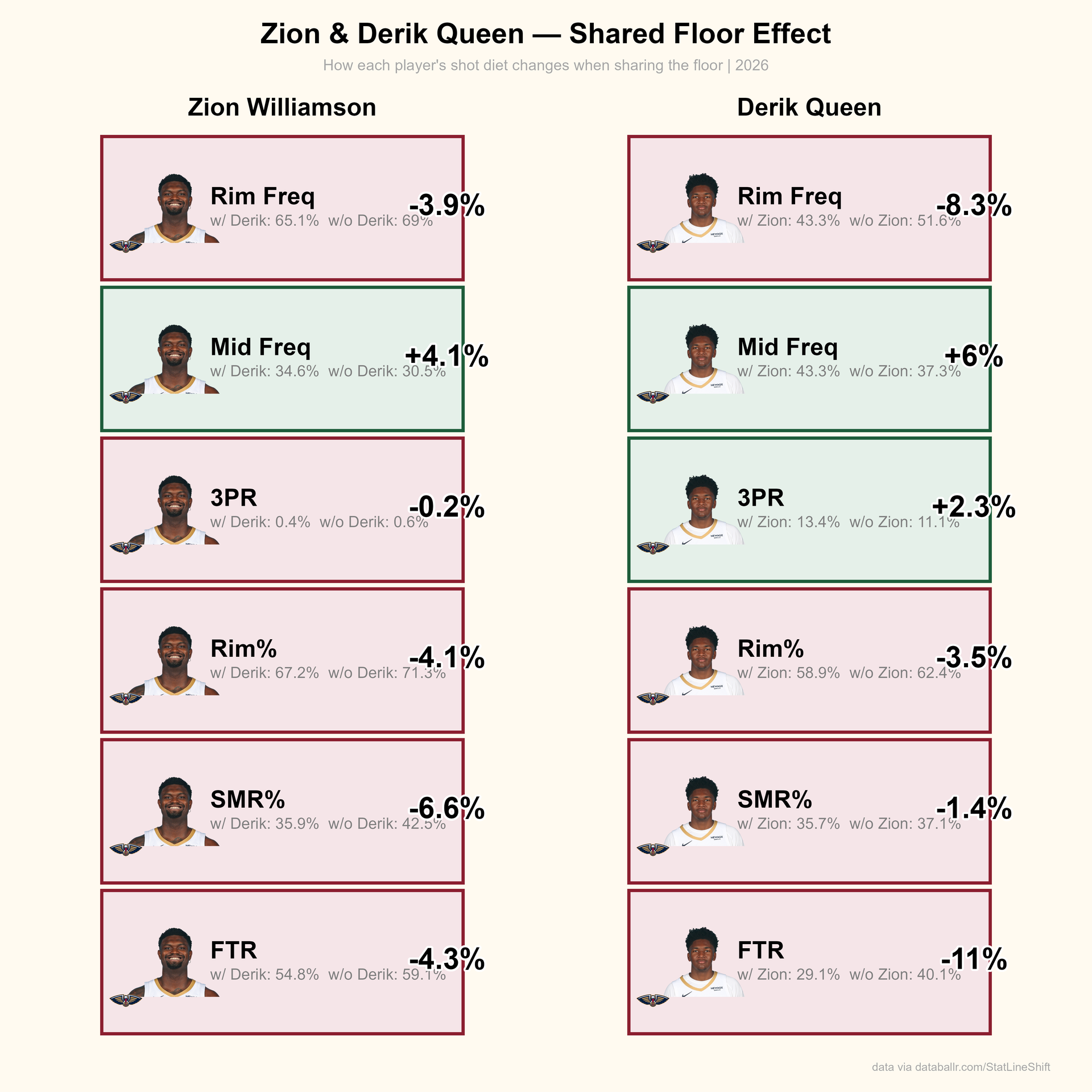
Not only does Zion suffer, but the graphic clearly indicates that Queen does as well.
Queen demands the same space to operate in creation playtypes as Zion does, but cannot do so slotted next to him.
What’s depicted in the graphic is an overall shift in shot diet from their norm to one that tilts toward their weaknesses, which in turn plummets their efficiency and causes their free-throw rate to deteriorate, for players who build their game around creating advantages and being fouled.
Queen getting his game off next to Zion is another headwind for a prospect that has a steep climb to finding his way to a quality career outcome. The physical tools and shooting woes are already roadblocks in his developmental journey, and making him share the court with Zion will interrupt him more than anything else.
All of the film displays that despite Zion having more play-finishing gravity, the spacing stays congested. And even when it isn’t, Queen is pushed away from the rim, especially when they’re in action together or sharing the same side of the floor.
This explains the less efficient rim % when Queen does end up getting there, and a lower free throw rate for a guy who had a strong 54.6 rate in college.
Nothing that either player does well is accentuated when the two play together; they are a hindrance to each other.
For them to have a chance on offense together at all, a positive synergy will be demanded on Queen spacing the floor — especially in their high-low game, where Queen is feeding Z.
Which, in all the tape I watched, is where I found them most directly effective together. They will have to rely on each other because no other offensive infrastructure supports them functioning together, specifically Queen’s passing brilliance finding Zion’s elite play-finishing.
The crux of this is a coaching staff investing in and emphasizing Zion in this play-finishing role, but most importantly, him engaging in these playtypes actively by seal early, whether from the front or back side, to get these quality looks that a playmaker like Queen can recognize.
In his 7 years as a pro, the dedication to the dunker spot, as a roller, and as a general off-ball player has been lacking for what you’d hope with someone who has the physical tools like Zion.
A poor man’s Jokic and Aaron Gordon, if you will.
There’s the positive spin; still, this requires growth that is far from easy to accomplish — the likelihood that both Queen adding consistent outside shot-making to his bag while forcing Zion to be invested when the ball isn’t in his hands, the odds are not in favor of this Brass’ bet.
Skill redundancy and the spacing dynamics of Zion and Queen in the frontcourt pose major obstacles to both winning their minutes.
Two players who not only bolster each other’s skill sets but struggle even to coexist… that’s the last thing you want to hear, especially when your VP of basketball operations is comparing them to a championship duo of Jayson Tatum and Jaylen Brown.
Beyond shrinking each other’s skill sets, the team suffers, too.
My question is, what does a Zion & Queen-powered lineup do well?
Somehow, their lineups get to the rim more, which sounds like a silver lining, though they hinder each other individually; it’s all for naught because the result is an abysmal 64.6% at the cup.
Funnily enough, it is better than what the Pelicans averaged on the year as a team, yet it still ranks in the bottom-5 overall in the league.
If your team’s shot diet performs horribly in what you’re trying to accomplish, then what kind of system are you constructing?
Looking at the location and efficiency distribution, the sirens loom louder.
My major issue is the total disregard for shooting threes or having any spacing at all; the front office has baked none of it into their team-building philosophies.
In the infamous 681 minutes pictured in the graphic above, Queen and Zion lineups had a 3-point frequency of 32.3. For context, that would be the lowest by any team since the 2020-21 season; that’s absolutely atrocious offense.
I promise you this isn’t the front office ambitiously fading league trends; it’s a dogmatic approach where they believe it isn’t mandatory to win.
The teams that have ranked towards the back of the pack in 3-ball rate while still putting out successful regular-season offenses would be Houston and Detroit. We saw how that panned out in the postseason, though!
Nevertheless, the way it translates to sustainable winning is killing on the offensive glass… newsflash, Zion and Queen lineups can’t offensive rebound either.
The Pelicans’ offensive rebound percentage takes a 3.5% hit in the Zion + DQ minutes, for a sad 26.5% average, ranking yet again in the bottom-5 among the field.
They also post a bottom-10 turnover rate of 15.1%, 1.1% more than what the Pelicans averaged this past season.
All this lineup data tells the story that we all saw game after game: the moments where either of these players shined were in spite of the other’s presence. Their time together didn’t provide unique value in any context.
The shot quality was poor; they couldn’t be in action together because it was too easy for other teams to guard, and they struggled to prop up the 3 other players they played with because of how redundant their games were.
Those of you begging for a hybrid stretch 5, like Kel’el Ware or Myles Turner, to alleviate these issues.
That’s a fine idea in theory, but:
- Stretch 5s are still incredibly rare, and the well-rounded ones are almost nonexistent.
- That archetype is only a band-aid for the skill-set overlap, and cannot solve the fundamental issues I’ve presented.
The Heart of the Matter
The issue is the lack of direction and awareness this organization continues to have. It can easily be tied back to their urgency to acquire Derik Queen; every draft junkie that had any fond thoughts of Queen as a prospect made it clear it was going to be situation-dependent regarding his development.
You have the front-facing executive who is supposedly spearheading New Orleans basketball who thinks Zion is the center of it all and is the worthy, most important egg in their basket.
And yet, the man he brought as his GM, Troy Weaver, to do his scouting, help negotiate deals, and ultimately build a roster, took this massive swing on Derik Queen. All while forcing him to play next to Zion in a toxic basketball relationship.
There’s nothing personal about it, but as basketball players, they are incredibly wrong for each other in a team-building context.
If Troy Weaver really wanted to Queen to thrive, he would’ve taken a hard look at the roster and said — “he’s not worth picking unless we give him the right opportunity to grow into the player I believe he can be.”
Which means taking Zion out of the picture, if the urgency was that grand.
Whether this is a disregard for the details and an assumption of ‘this will work itself out’ — which is what Dumars the quote in the intro of this piece comes across as — or a ‘my guy is Queen, so I’ll go and get him regardless of the consequences’.
All of this is a poor reflection on this front office, and despite all the criticism they get, this concept doesn’t get discussed enough… (I’ve said it before; and I guess it’s a first-world problem considering all the other issues this team has at hand) But they do not understand what they’re trying to create on the hardwood.
Toughness and grit are closer to hoops word salad when you’ve produced a roster that has no identity, when you went and got Jordan Poole and Saddiq Bey — offensively slanted, score-first players… when you drafted Derik Queen, who is slanted the same and plays more like a Euro-Big than a traditional, hard-nosed classic 4 or 5.
Specific to this piece, and this is where I’ll state the obvious about what every sensical basketball watcher already knows — Zion and Queen lineups don’t give you those things.
There are obvious defensive deficiencies when these two share a frontcourt.
In their minutes together this season, the Pelicans gave up 31.8% of their shots at the rim, which would’ve ranked 4th last this past season among all teams, and said opponents shot 69.4% at the rim, which would’ve ranked around 8th last.
Joe Dumars in the supposed “no easy buckets era,” which is equated to toughness, so what’s tough about Zion + DQ letting teams feast at the rim without a fight?
Additionally, their lineups together didn’t force turnovers either, another part of basketball that stereotypically goes hand in hand with grit and sweat-equity. Not only do they force an opponent turnover percentage of 13.2%, essentially another bottom-5 rate in the league, but the Pels turn their opponents over 1.2% more on average and 1.5% more when both of these guys are on the bench.
So the two of them don’t win more possessions through the turnover battle or second-chances on the offensive glass, don’t defend any area of the floor well, especially beyond the arc and at the rim, aka the two areas on the floor that most teams are trying to center their shot diet on.
To put it in basic terms, teams are getting exactly what they want when the Pelicans roll out Zion and Queen together.
In fact, they'd rank in the bottom five in terms of 3-point frequency allowed, and it’s not like they’re welcoming tough looks from outside because teams are shooting 37.3% from the arc against their lineups; that makes for a bottom-three 3-point defense in the NBA.
Nothing about this even whispers tenacity.
This is a long-winded way of saying their “justification” of how Zion and Queen can function together and carve out success in the NBA is THE proof in the pudding that this front office has lost the plot.
If they do not understand why those guys cannot and will not ever figure it out, then they aren’t deserving of any credit or confidence from the fanbase as to what they are building towards.
It’s the flashing sign in all caps saying they aren’t paying attention and conceptualizing the basketball product they’re putting out in the Blender.
People think Dumars and Weaver are confident this team can run it back because the lack of offseason activity represents that idea… it could be true.
Or maybe what they’ve done has been so scattered, and therefore has been justifiably criticized, so much so to the point that they’re frozen and hoping for any light or sign that could point them in the right direction.
A front office that, over two offseasons, has yet to plant its own flag on any team-building philosophy or indicate they’re mapping out the future is the exact antithesis of what the modern NBA is now. As a result, the Pelicans are plummeting straight into irrelevance with one hell of a wreckage to clean up for the next front office that comes through here.
Be sure to follow me on Twitter/X @giddhoops!
A quick share helps us a lot!