Thursday: Inside the NBA

Chrissy Smith • August 13, 2026

How Other Contenders Have Built Around Their Stars

NEW ORLEANS -- Building around a superstar sounds simple, right? Find your star. Add good players. Win games. But in reality, the NBA's best teams understand that the players surrounding a star have to fit the way that star plays.

That's something the New Orleans Pelicans can learn from the teams they've been chasing. When you look at the Oklahoma City Thunder, they didn't simply surround Shai Gilgeous-Alexander with scorers. They built a team around his strengths: shooting, length, versatility and players who can defend multiple positions. That formula helped Oklahoma City win 64 games in 2025-26, while SGA won his second consecutive MVP.

Denver took a different approach with Nikola Jokić. The Nuggets built an offense around his extraordinary ability to pass and score from the center position. Rather than asking Jokić to fit into a system, they built the system around him.

The lesson for New Orleans isn't to copy either team. Instead, it's to understand Zion Williamson. Zion's greatest strength is obvious: When he gets downhill, very few players in the NBA can stop him. That means the Pelicans need to create as much space as possible around him.

This is where shooting matters as well as secondary playmaking. Additionally, having defenders who can cover for weaknesses and allow Zion to conserve energy for the offensive end is just as important.

That's why players like Trey Murphy III and Herb Jones are so important. Murphy's shooting creates space. Jones' defense provides versatility. Players like Jordan Poole and Dejounte Murray can create offense when Zion isn't initiating.

But the Pelicans also need to answer a bigger question:

Are they building around what Zion does best, or simply putting talented players next to him? Those aren't necessarily the same thing, and the best contenders build with purpose. Every player has a role, and every role complements the star.

So the Pelicans don't need to recreate Oklahoma City or Denver, but they need to figure out what a championship-caliber team around Zion actually looks like.

If New Orleans can surround its best player with shooting, defense, secondary creators and players who complement his unique strengths, the roster suddenly looks much more dangerous.

The goal isn't to collect talent. It's to build a team that makes your best player better.

Understand the Pelicans. Don't just watch them.


A quick share helps us a lot!

Tulane Athletics logo with green wave mascot on a blue background
By Patrick Harkness • September 27, 2026
Tulane football is not short on players who will compete. That much was clear in the 28-24 win over South Alabama, when the Green Wave found a way at Yulman and reminded everyone what this roster can look like when the plan matches the talent. The problem sitting over this 2-2 start is not effort in the locker room. It is decision-making in the offices above it. From the December search to the portal to the Week 1 depth chart to who is wearing the headset on Saturdays, the staff has spent nine months choosing caution when the moment called for conviction. The players have been asked to live with those choices. That is the story of this season so far. The hire that set the tone: When Jon Sumrall left for Florida after a College Football Playoff run, Tulane held one of the best Group of Five jobs in the country. The search did not treat it that way. Blake Baker, a former Green Wave linebacker and then LSU’s defensive coordinator, was the first choice. Tulane interviewed him. Memphis interviewed him. Lane Kiffin used that interest the way a Power program uses it. He kept Baker in Baton Rouge on a three-year deal reported at $9.3 million. Baker later said the alma mater pull was real, then said there was “not a better defensive coordinator job” than the one he already had. Tulane became the leverage, not the landing spot. By the time Baker was off the board, the rest of the short list had moved. Bob Chesney went to UCLA. Charles Huff went to Memphis. Billy Napier landed at James Madison. Jason Candle took UConn. The window closed, and the athletic department promoted from inside. Will Hall knows this place. He coordinated the offense here in 2019 and 2020. He came back in 2025 as passing-game coordinator. Continuity after a historic year had an argument. It was also the option left after the favorite used the opening to get paid at LSU and every other serious name took a job elsewhere. A championship program spent its most important offseason decision waiting, then settled. That is how the year started. It is also how the year has been coached. Caution in the portal: Hall was open about the quarterback plan. The staff did not want to “over-sign transfers and squish the development” of the young players already in the room. The idea was two older quarterbacks to compete, then let Trace Johnson, Jay Beamon, Bruno and Cade Scott grow behind them. That sounds careful. In this sport, it also sounds like a staff more worried about hurting feelings in the meeting room than about winning the first month. The previous year Sumrall brought in 4 potential guys fighting for one job. Jake Retzlaff was gone. The 2025 offense ran through him. The response was not a finished portal veteran who had just won at this level. The response in the portal was way more to be desired. The same hesitation showed up on the DL. The Wave added players. What the staff did not add was a true veteran pass-rush closer, the kind of player who wrecks a game in September while a new defensive staff is still installing, granted that was supposed to be McCallister but he is no longer on the roster. Through the first three games Tulane had one team sack. A defense that posted 34 sacks across 13 games a year ago was generating almost nothing. That is not the players failing to rush. That is a personnel plan that asked a transitioning front to create pressure without the one piece that makes a new scheme look fast. Protect the room. Don’t scare anyone into the portal. Those are coaching and front-office choices. They have shown up on third down, run defense, and pass rush. Week 1 starter Decision: Chriss-Gremillion at Duke. Hall cited experience, dual-threat ability, fewer turnovers in practice, and speed. That is a coaching evaluation. It is also the evaluation that put the wrong plan on the field for the opener. Duke 17-3. Chriss was pulled at halftime. Semonza finished the game and started the next one. Against South Alabama he threw for 212 yards, Jaylin Lucas ran for 214, and Tulane won 28-24. Led an amazing comeback and beautiful throw. None of that is an indictment of Chriss as a player. He did what the staff asked him to do in a system still being installed. The mistake was the decision itself: taking the more natural passer off the card for Week 1 on the road against a Power conference defense because the staff liked the look of the dual-threat package in August. Starting Semonza a week later was the correction. The correction should not have been required. I like Semonza a lot and want nothing more than success for him but he is not a finished product. No quarterback in this room is, because the staff chose not to bring in a finished one. That, again, is on the people drawing the depth chart. Callaway on the headset: Russ Callaway is in his first season as Tulane’s offensive coordinator. He held the same title at Florida a year ago. He last called plays as a primary play-caller at Samford. The offense this fall has looked like a staff still arguing with itself about what it wants to be. The scoring line is the tell: 3 points at Duke, 28 at home against South Alabama, 20 at Kansas State, 24 against USM. 18 points per game. Three hundred fourteen yards per game. When Lucas gets 214 on the ground, this team can win a one-score game. When the run game is contained and the passing attack has to carry a series, the operation slows down and the play sheet feels a series or two behind. That is not receivers dropping balls (minus USM) or backs missing holes as a rule. It is structure. Protection. Tempo. Play selection on second-and-medium. The things a play-caller is paid to solve. Hall is an offensive coach. That is why he was hired. Leaving the call sheet with a first-year coordinator while the offense searches for an identity is the same pattern as the hire and the portal: defer, protect, wait. The first change should be the headset. Will Hall should call the offense from here on out. That is not a public firing. It is the head coach taking ownership of the unit he was sold as being able to run. A defense that has not been put in position to look like itself: Tayler Polk inherited real pieces. Jack Tchienchou and Dickson Agu are still here. Chris Rodgers (Hurt) is still here. Kevin Adams III has been around the ball. The names are familiar. The results have not matched the standard this program set a year ago. Tulane is allowing 24 points and 429 yards per game. Opponents are running for 211 yards a night. The pass rush has not arrived until they played a bad USM team. The players are tackling and competing. They are not dictating, because the staff did not give this front the veteran disruption it needed and has not yet found a way to manufacture it with what is here. Granted some positives did come from USM. A playoff defense does not become average because the calendar flipped. It becomes average when the scheme and play-calling haven’t been up to par and need to be re-tooled. Give Trace Johnson a real plan: Trace Johnson is a true freshman. He is also the best pure passer on the roster, and people inside the building have said as much since spring. Hall has called him driven, accurate, and the kind of player who would have carried a different recruiting label if he were three inches taller. Johnson was in the offices watching film at 5 a.m. the morning after he was told he was not in the Week 1 mix. That is not a kid hiding from the moment. That is a kid the staff recruited as the next Pratt or Mensah, then parked. From here on, he should get a shot. Not a garbage-time cameo. A plan. If the offense keeps settling, the coaching staff owes this season a look at the quarterback it asked fans to be patient for. Protecting the room in January only works if the room is used. Using it means Johnson is in the conversation now. What is still true: The South Alabama win was not a fluke of officiating or weather. It was this roster when the staff simplified enough to let the skill players work. Lucas looked like the most explosive back on the field. Johnnie Daniels and Maurice Turner give Tulane a backfield that can tilt a game. Destyn Hill and Anthony Brown-Stephens can take the top off a coverage. Tchienchou, Agu, and Adams will play. The locker room that went to Oxford in December did not forget how to compete in nine months. Hall knows Yulman. He knows this city. The American schedule is still in front of them, Army, Memphis, UTSA, the November stretch. None of that is closed. A 2-2 start in a transition year is not a death sentence if the next set of decisions is better than the last one. The last year-plus has been a study in hesitation at the top: letting Baker walk the job to a raise in Baton Rouge, refusing to crowd the quarterback room, passing on veteran edge help, naming the wrong starter in Week 1, and handing the offense to a coordinator still finding the fit. The players have answered when they have been put in position. The correction is not a press conference about culture. It is Hall taking the headset, Johnson getting real snaps, and this staff coaching the roster it has like a playoff program it is. South Alabama showed what this team looks like when the decisions catch up to the talent. That version is still available. The rest of the season will tell us whether the people making the choices are done being careful. Look you may not agree with me on this or like it, but I’m just trying to be 100% honest with how I feel with the state of Tulane football. I love this team to much to settle for mediocrity. I want nothing more than success for all the players, Tulane and its coaches now and in the future. Hopefully in Jan we can look back at this and say I was dead wrong and everyone can call me an idiot. Nothing would make me happier! #RMFW #RollWave #WinTheAAC Make sure to follow Patrick Harkness on X

By Bobby Autin • September 27, 2026
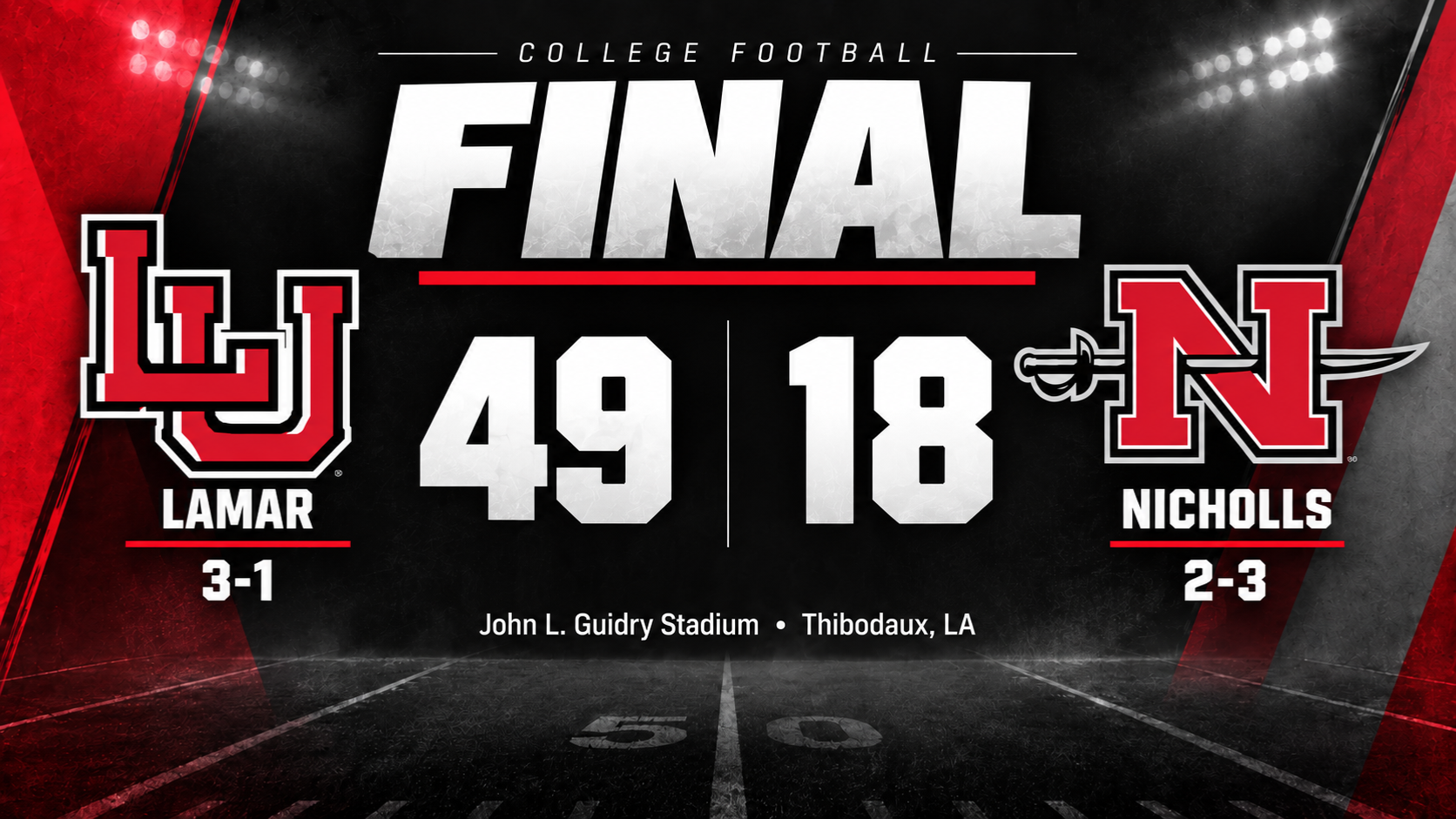
THIBODAUX, La. — Nicholls spent most of Saturday afternoon trying to recover from a first half that got away from the Colonels in a hurry. Lamar scored 28 points in the first quarter and took a 42-10 lead into halftime before going on to defeat Nicholls 49-18 at John L. Guidry Stadium. The Cardinals finished with 439 yards of offense and created big plays through the air, on the ground and on special teams. By the time Nicholls found some answers defensively in the second half, the deficit was already too much to overcome. Lamar Starts Fast It did not take long for Lamar to set the tone. Aiden McCown connected with Blake Thomas for a 41-yard touchdown on the Cardinals’ opening possession. On Lamar’s next drive, McCown found Davin Driskell for a 49-yard score to make it 14-0. Nicholls answered with one of its better drives of the afternoon. Ean Rodrigue led the Colonels 65 yards on 10 plays, finishing the drive with a 3-yard touchdown pass to Ellis Stewart. That brought Nicholls back within 14-7 with 9:55 remaining in the first quarter. The momentum did not last long. Caleb Holmes took the ensuing kickoff 86 yards for a touchdown, putting Lamar right back in control at 22-7. McCown then added his third touchdown pass of the quarter on the final play of the first, finding Cam Patterson from 11 yards out. Lamar led 28-7 after just 15 minutes. Cardinals Continue to Pull Away Nicholls was able to keep Lamar off the scoreboard for part of the second quarter, but the Cardinals eventually put together two long touchdown drives. Parker Jenkins finished a 12-play, 79-yard possession with a 1-yard touchdown run to make it 35-7. Later in the quarter, LaDamion McDowell capped a 10-play, 68-yard drive with an 11-yard touchdown run. That pushed Lamar’s lead to 42-7. Nicholls was able to add points before halftime when Kingston Phan connected on a 43-yard field goal, but the Colonels went into the locker room trailing 42-10. The biggest problem for Nicholls in the opening half was not just that Lamar was moving the football. It was how quickly the Cardinals were creating points. Lamar had touchdown passes of 41 and 49 yards, the 86-yard kickoff return and scored on six different possessions before halftime. Nicholls Defense Settles Down The third quarter was a completely different game. After allowing 42 points in the first half, Nicholls held Lamar scoreless in the third quarter. Skylar Husband also came up with the Colonels’ lone takeaway of the afternoon when he intercepted McCown. Nicholls was not able to turn the improved defensive play into points, however, and the score remained 42-10 heading into the fourth. The Colonels also struggled to stay on the field offensively throughout the game, finishing just 3-of-15 on third down and 2-of-4 on fourth down. Colonels Find the End Zone Again Nicholls finally broke through again early in the fourth quarter. Rodrigue found Jordan Smith for a 29-yard touchdown to finish a 12-play, 89-yard drive. Rodrigue then connected with Stewart for the two-point conversion, cutting the Lamar lead to 42-18. But once again, Lamar answered. McCown broke free for a 56-yard touchdown run on the Cardinals’ next possession, giving Lamar its final points of the afternoon and pushing the lead to 49-18. McCown ended up hurting Nicholls in just about every way possible. He finished 13-of-19 passing for 232 yards, three touchdowns and one interception. He also rushed six times for 80 yards and the 56-yard touchdown. Driskell led Lamar through the air with four catches for 110 yards and a touchdown. Rodrigue Leaves in Fourth Quarter One of the bigger stories coming out of the loss may be the status of Rodrigue. The Nicholls quarterback left the game in the fourth quarter with an apparent shoulder injury and was replaced by Preston Welch. Rodrigue finished 18-of-31 for 191 yards, two touchdowns and no interceptions. He also rushed nine times for 46 yards. Welch attempted two passes after entering the game but did not complete either. There was no immediate update on the extent of Rodrigue’s injury. By the Numbers Jordan Smith led Nicholls with six catches for 78 yards and a touchdown, while Greg Donaldson finished with five catches for 75 yards. Shane Lee led the Colonels on the ground with 64 yards on nine carries. Nicholls finished with 138 rushing yards as a team. Lamar outgained Nicholls 439-329, including a 246-191 advantage through the air and a 193-138 advantage on the ground. The Cardinals also finished with 23 first downs compared to 19 for Nicholls. One area that continued to hurt the Colonels was penalties. Nicholls was flagged 12 times for 111 yards, compared to eight penalties for 65 yards for Lamar. Nicholls did win the turnover battle. Husband’s interception was the only turnover of the game, while the Colonels did not give the football away. But the early deficit, explosive plays and inability to consistently extend drives proved to be too much. Lamar left Thibodaux with a 49-18 win after doing most of its damage in a first half that put Nicholls in a hole it was never able to climb out of. Nicholls Recognizes 2026 Hall of Fame Class Before kickoff, Nicholls also took time to recognize its 2026 Hall of Fame Class along with its newest Hall of Distinction selection. The six-member Hall of Fame class included Jacob Bender, Terrel Castle, Kasey Frederick, Chuck Hickman, Ashley Ray and Kadi Whisnant. Norby Chabert was also selected for the Hall of Distinction. Bender was a standout offensive lineman for the Colonels from 2003-06 and earned FCS All-American Third Team honors as a senior. He was also a two-time All-Southland First Team selection and helped Nicholls win its first Southland Conference championship in 2005. Castle played two seasons for the Colonel men’s basketball team and was a key part of the 1994-95 Southland championship team. He averaged 14.6 points and 3.5 assists during his Nicholls career and helped the Colonels finish 24-6 in his final season, still the most wins in a single season in program history. Frederick was a three-time All-Southland selection during her softball career and earned first-team honors twice. She finished her career among the program leaders in RBIs, home runs, doubles and total bases and helped Nicholls win the 2018 Southland regular season title. Hickman was one of the most productive hitters in Nicholls baseball history. The former shortstop recorded more than 90 hits in each of his final two seasons and set a single-season school record with 93 hits in 2002. He finished his Colonel career with a .364 batting average. Ray put together one of the best two-year stretches in Nicholls softball history. She was named the Southland Conference Player of the Year and Newcomer of the Year in 2011 after hitting .368 with a school-record 17 home runs. She finished her career with a .361 batting average and a program-best .677 slugging percentage. Whisnant earned 12 letters while competing in cross country, indoor track and outdoor track. She became just the second Colonel to win back-to-back 3,000-meter steeplechase championships and left Nicholls as the school record holder in the event. Chabert was honored through the Hall of Distinction for his continued support of Nicholls and its athletic programs. A Nicholls graduate and former Louisiana State Senator, Chabert has been a longtime advocate for the university and its athletic department. The group was recognized before Saturday’s game against Lamar, adding another moment to the day at John L. Guidry Stadium before the Colonels and Cardinals took the field.
Show More