Louisiana Tech falls behind late in loss to LSU after eventful defensive first half
Week 2 Recap: LA Tech @ LSU
Paid to Play Hard
Some people may have managed to correctly predict a score or player statline here or there for this game, sure. Most anyone you spoke to would’ve chosen LSU to have beaten Tech handily in all aspects of the game. All of these things being true, I can tell you with 100% confidence that no one on God’s green earth would have ever expected Louisiana Tech to go into half-time only trailing by three points. I’m even more confident that you would never have predicted Tech to have four total takeaways on defense in one half. Something maybe a little more predictable was the bulldogs offensive failures that persisted throughout the entire game barring 4-5 total plays. Louisiana Tech’s defense fought very hard in this game, which is why there was any chance of competition at all. However, once a mind-boggling number of scoring opportunities were wasted, defense could only do so much and the bulldogs lost the game 14-45 while being paid $1.6 million to give Tiger fans hell for 30 minutes.
Offense = Ehhh
I’m starting with offensive reflections because it is what ends up disappointing the most when you look back at this game and so later we can talk about upside with the defense. Quarterback play is what will be taking a lot of the attention when you review the film of this game. Good and bad, really. I can say I actually really liked Blake Baker’s ability to step up in the pocket, find safe space under pressure, and take sacks instead of forcing balls that lead to turnovers. That being said, Blake was unable to use his pocket prowess in this game to create positive plays. Instead, he often held onto the ball for way longer than one ever should facing a (Defensive Coordinator) Blake Baker defense, leading to many, many sacks and loss of yardage that damaged the team’s field position. All throughout this game I was thinking to myself about how crazy it was that Blake was getting so much time to throw the ball and to do so little with so many opportunities is just disheartening. It wasn’t all his fault though, as I feel that the same game plan that was used to make him look excellent against Northwestern State the week before was abandoned in this matchup. Against the demons, we watched Baker complete a multitude of quick, designed throws meant to get good targets open fast and he was hitting them accordingly. In addition, a strong execution of RPO’s and clever trick plays led to quick explosive sprinkles in the game. I saw almost none of this against LSU and it does confuse me just a little. Why stay away from something that seemed to work so well before? Why force Blake into situations that made him read a defense led by one of the best coaching minds in the sport? I am not a coach nor an official analyst so please do not take my opinion too seriously, but I felt like OC Nathan Young strayed away from a game plan that would have had more success in this environment. Baker finished the game 11/21 on passing with 128 yards and one touchdown, along with an INT as he took seven sacks.
The offensive line showed real promise in pass protection…sometimes. Constant bouncing around to pick up rushers and general positive execution in dropbacks, although a lot of the time Baker had to throw was self-made in reaction to allowed rushers. Baker did face 29 QB pressures in this game. Of the seven sacks given up in this game, I would really only actually attribute three or four to the offensive line. I thought that they did alright given their competition but again I live in constant fear of any of these guys going down due to injury. I have less faith about inside runs than I had even last week after another generally unsuccessful stint at any kind of internal zone play. Running in general was a struggle, with a net rushing yard total of -3 in this game. Negative yardage on runs will not win anything. The lack of third downs don’t help with the additional opportunities to hand the ball off, nor do repetitive negative plays. Andrew Burnette led the team in rushing with 16 yards on six carriers. Dylone Brooks was in the game for a handful of snaps but did not receive any carries.
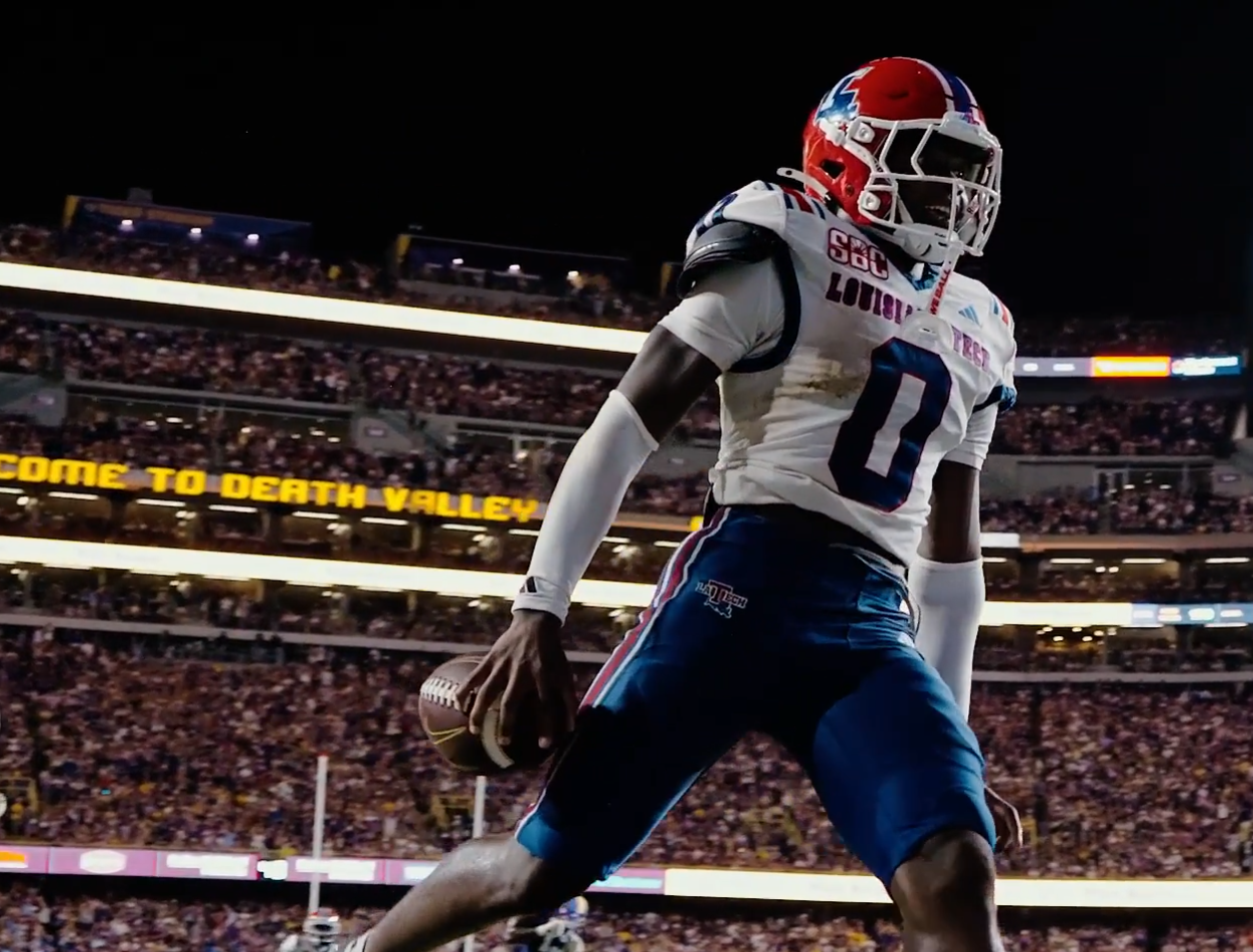
The best thing one can talk about in this offense is Jalen Mickens yet again. Mickens has managed incredible production through just two games, most coming from YAC resulting from pure speed. Mickens had six receptions in this game for 101 yards and a touchdown that came on his 67-yard sprint up the middle of the field. Through two games, Mickens has totaled 234 receiving yards on nine catches, averaging 26 yards per catch. He has two touchdowns already and has far surpassed his freshman year production last year on 11 less receptions. Eli Finley also continues to receive targets which does help, but I want more scheming for him like we saw in week one.
Striking Fear
The most exciting and enjoyable part of this game to talk about is going to be the defense, which played well enough to earn their letters in one evening alone. Louisiana Tech started the game on defense after LSU won the coin toss and elected to receive. From a coaching perspective, I thought it was an odd decision in general, but I assume that Kiffin was trying to strike first quickly to make a statement and excite his crowd. Regardless of his plan, the Bulldogs made it quite clear that they would not be so easily conquered and forced a three-and-out on LSU’s first offensive possession. The finishing blow on this defensive stop came as Kolbe Fields and Alonzo Jackson Jr. tracked Dillin Jones to the sideline with haste to force a loss of three on third down and a subsequent punt.
After this, Tech’s defense would have a stout goal line stand, holding LSU to three points before giving up an explosive 3-play drive for a touchdown once LSU got the ball back. However, that would be the last time LSU would score in the first half. After forcing another punt, Tech had to give the ball back to LSU and as the Tigers attempted to work their way up the field, Jordan McCrae would force a fumble that was recovered by Janard Lockhardt and returned 35 yards upfield. The next time LSU would have the ball, Tech forced an interception by Kam Franklin at their own 40. Next, Jordan McCrae was put in position to have yet another defensive takeaway that he returned for a 100-yard touchdown, the longest interception return for a touchdown in program history. In LSU’s fourth straight drive, they turned the ball over a fourth straight time as Zheric Hill caught a tipped ball in the redzone. In this first half, LA Tech did indeed hold LSU to only 10 points even though the Tigers managed to make it to the redzone four total times. Four takeaways on four straight LSU possessions.
All good things have to come to an end though, especially when offenses struggle on second, third, and even fourth chances to make sparks fly. Tech would proceed to allow four more touchdowns in the second half with no more takeaways to celebrate about. A blocked field goal would be called back for offsides and while the front seven continued to fight all game (mostly succeeding at stopping the run and making two goal line stands), the second level suffered in coverage and even tackling.
At the end of the game there were still many positive things to come away with. Alonzo Jackson Jr. had himself a generational day, garnering 3.5 TFL’s, three sacks, a pass breakup, 12 total tackles and eight solo tackles. He was involved in almost every play from start to finish and after his interception last week, will be ripping away segments of the field for any opposing quarterback moving forward. Defensive Lineman Lane Condry had an impressive two sacks in his limited snaps and Sam Fongang continued his involvement with five solo tackles and two TFL’s. Other DB’s such as Jordan McCrae, Ty Jones, and Taeden Rogers also were heavily involved with consistent open-field tackles and defensive coverage in this game. Jaden Mayfield and Kolbe Fields had quieter nights, but still contributed well to protect the lower level of the midfield from easy passes and continued good pursuit of ballcarriers.
Like I mentioned before, consistently stopping the run was another welcome surprise from the defensive front. It is hard to express how proud I was of our guys for being so physical inside. Similar to the game against Northwestern State, very little success was found from LSU attempting to run the ball down our throat and they did certainly try. Most often, run plays by either LSU’s running backs or Sam Leavitt were forced outside and if they made it there, they had a chance for success, especially earlier in the game. Even then though, Tech’s redzone defense proved to be a defiant force and had a shove that beat a group that is being paid a lot of money just to make holes.
Conclusions
While before I thought it would be quite difficult to learn anything about either teams in this matchup, now I believe there are numerous things to take away. For one, LSU fans learned that their quarterback may not be worth the $6 Million he is being paid. I think the whole nation learned that this Tech defense is not to be taken lightly, with a stout front seven and playmaking defensive backs yet again. Luke Olson is proving that his worth as a coach is even more valuable than we thought (and we thought it was to the MOON). Our team is beginning to shape into what it was last year at the start and that does start to scare me–defensive success with lackluster ability to move the football on the other side. I’m hoping that Nathan Young really leans into the run game to alleviate pressure from our quarterbacks here on out. At least he understands the most valuable parts of the receiving game so far. Baylor is just around the corner and DJ Lagway better be ready to deal with the ball hawks here from Ruston.
A quick share helps us a lot!